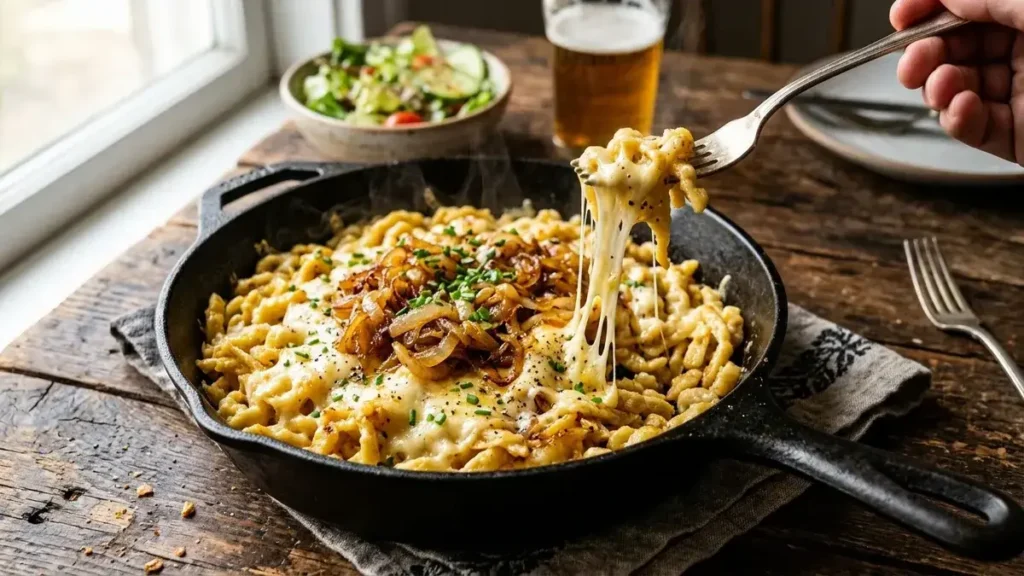
TL;DR: Great cheese spätzle has springy, hand-shaped egg noodles, real mountain-style cheese, and sweet browned onions. Check menus for käsespätzle, ask about the cheese, and look at the noodles. Can’t find a good plate nearby? The home version takes about 40 minutes.
You know that moment when a dish arrives and you can smell the browned butter before the plate touches the table? That’s what a proper plate of cheesy spätzle does. It’s soft, stretchy, savory, and topped with onions that taste almost candy-sweet.
If you’ve been typing “best spatzle with cheese near me” into your phone, you’re probably hungry and a little skeptical. Fair. The dish is simple, which means the difference between a great plate and a sad, rubbery one comes down to a handful of details. This guide shows you what those details are, how to find a restaurant that gets them right, and what to do when nobody nearby does.
Quick Overview
- What it is: Small egg noodles tossed or layered with melted cheese and topped with fried onions
- Where it’s from: Swabia and the Allgäu in southern Germany, plus Austria, Switzerland, and Liechtenstein
- Key cheeses: Emmentaler, Allgäuer Bergkäse, or a blend of the two
- Best sign of quality: Irregular, springy noodles, not uniform pasta shapes
- Usual side: A crisp green salad to cut the richness
What Exactly Is Cheese Spätzle?
Definition: Käsespätzle (German for “spätzle with cheese”) is a traditional dish of Swabia, Baden, and the Allgäu. It’s made from soft egg noodles layered with grated cheese and topped with fried onions.
Spätzle themselves are a cross between pasta and dumplings. The batter is loose and sticky, and it gets pushed through a press or scraped off a wooden board straight into boiling water. That’s why the noodles come out in uneven little ribbons and nubs instead of neat, identical strands.
Plenty of people call it German mac and cheese, and that’s a handy shortcut. But it’s a different animal. The noodles are eggier and chewier, the cheese is nutty rather than orange and processed, and the onions add a sweetness you won’t find in the boxed stuff.
The dish is a pillar of regional cooking. A University of Notre Dame student blog from the Swabia region lists Käsespätzle alongside Maultaschen and Swabian pretzels as one of the area’s three major traditional foods. If you see it on a menu, you’re looking at something people there grew up eating.
How Can You Tell Authentic Cheese Spätzle From a Bad Imitation?
Look at the noodles first. Real spätzle are irregular, with rough, slightly porous surfaces that grab onto cheese. If every piece looks identical and glossy, someone probably used a shortcut product or a mold.
Then check the texture. Good noodles are tender with a little bounce, never mushy and never hard. They shouldn’t be swimming in a pool of cream, either. Traditional versions rely on melted cheese and butter, not a heavy sauce.
The onions tell you a lot, too. They should be cooked low and slow until deep golden and sweet. Burnt, bitter onions or a sprinkle of dried crispy onion from a can are red flags.
Here’s a quick way to size up a plate:
- Noodle shape: uneven and hand-made looking is good
- Cheese: stretchy, nutty, and melted into the noodles
- Onions: golden, sweet, and piled on top
- Serving style: often in a hot skillet or baking dish
- Side: a simple green salad
Which Cheeses Belong in Käsespätzle?
Cheese is where this dish lives or dies. In Swabia, cooks traditionally use Bergkäse (a mountain cheese), Emmentaler, or a mix of both. Allgäuer Bergkäse brings a sharper, nuttier punch, while Emmentaler melts into silky strands and adds mild sweetness.
Here’s how the common options compare:
| Cheese | Flavor | Melt quality | Why it works |
|---|---|---|---|
| Emmentaler | Mild, slightly sweet | Excellent, stretchy | Gives that classic cheese pull |
| Allgäuer Bergkäse | Nutty, bold | Good | Adds depth and a savory edge |
| Gruyère (common substitute) | Rich, earthy | Excellent | Easy to find outside Europe |
| Mild cheddar (not traditional) | Tangy | Okay, can turn greasy | Fine in a pinch, but it changes the flavor |
If a restaurant tells you it uses a blend of Swiss-style mountain cheeses, that’s a very good sign. If the menu just says “melted cheese,” ask what kind. A cook who’s proud of the dish will happily tell you.
Where Can You Find the Best Spatzle With Cheese Near Me?
Start with German, Austrian, and Swiss restaurants, but don’t stop there. Alpine-inspired gastropubs, craft beer halls, and ski-town kitchens often put cheese spätzle on the menu as a hearty comfort dish. Some bakeries and delis with a German focus sell it by the portion, too.
Here’s a simple search routine that works better than scrolling random reviews:
- Search the German spelling. Try “käsespätzle,” “Kasspatzln,” or “Käsknöpfle” along with your city. Menus often use the regional name.
- Check photos, not just stars. Customer photos show you the noodle shape and onion color in seconds.
- Read menus for the cheese. A named cheese beats a vague description every time.
- Look for German-style beer halls and Oktoberfest pop-ups. They tend to serve the dish seasonally.
- Ask local food groups. Neighborhood forums and city food communities usually know who’s doing it right.
One honest caveat: depending on where you live, there may simply be nobody making it. That’s not a failure of your search. Spätzle are a regional specialty, and they’re rare in some cities.
What Should You Ask or Look For on the Menu?
Don’t be shy about asking questions. A few simple ones will tell you almost everything.
Ask whether the spätzle are made in-house. Fresh noodles take a little effort, and kitchens that do it usually say so proudly. Ask what cheese goes in, and whether the onions are fried to order or pre-made.
You can also read the description for clues. Words like “baked,” “layered,” or “served in the skillet” suggest a traditional approach. Menus that say “creamy” or “cheese sauce” often point to a mac-and-cheese style take, which isn’t bad, just different.
Price isn’t a perfect guide, but it helps. Handmade noodles and real mountain cheese cost more than boxed pasta and shredded blends, so a suspiciously cheap plate deserves a second look.
Can’t Find a Good Plate Nearby? Make It at Home
Honestly, this is where a lot of fans end up. Cheese spätzle is a forgiving dish once you’ve made it a couple of times, and you don’t need fancy equipment.
The basic idea:
- Mix flour, eggs, a splash of milk or water, salt, and a pinch of nutmeg into a thick, sticky batter. A rough starting point is about 2 cups of flour to 3 eggs, adjusted until the batter drips slowly off a spoon.
- Push it through a spätzle press, a large-holed colander, or scrape it off a small board into simmering salted water.
- When the noodles float, scoop them out and drain them.
- Layer them with grated cheese in a warm baking dish and slide it into the oven until everything melts together.
- Top with onions slowly browned in butter.
Egg-based dishes call for a little care. The USDA-backed FoodSafety.gov chart of safe minimum cooking temperatures lists 165°F (74°C) for leftovers and casseroles, which is worth remembering when you reheat extra spätzle the next day. Reheating in a skillet with a bit of butter also brings back the texture.
Homemade versions have a bonus: you control the cheese. Use a real Emmentaler or Bergkäse and you’ll beat plenty of restaurant plates.
What Should You Serve With Cheese Spätzle?
Tradition says a green salad. In Swabia, Käsespätzle are served with one because the acidity cuts through the richness. A simple lettuce salad with a sharp vinegar dressing is plenty.
Other pairings you’ll see:
- Applesauce: common in Vorarlberg and Liechtenstein, where the sweetness plays against the salty cheese
- Potato salad: a hearty option that works especially well in cooler months
- A crisp lager or wheat beer: the classic restaurant pairing
- A dry white wine: Riesling or a Grüner Veltliner works nicely
If you’re serving it as part of a larger meal, keep everything else light. The dish is rich enough to be a full dinner on its own.
Does the Dish Change From Region to Region?
It does, and this is part of the fun. The same idea shows up under different names across the Alpine region, and each version has its own personality.
In Swabia, you’ll usually see Käsespätzle made with Bergkäse, Emmentaler, or both. In the Allgäu and Vorarlberg, you’ll hear Käsknöpfle (the noodles are shaped as small “knöpfle,” or little buttons). In Tyrol, it’s often called Kasspatzln, and a cousin called Kasnocken shows up there too.
Some cooks add bacon for a smoky note, and others fold in herbs or spinach. These are all reasonable twists. Just remember that when a restaurant calls something “traditional,” the cheese, onions, and hand-shaped noodles should still be there.
Key Takeaways
- Real cheese spätzle uses irregular, handmade egg noodles, not uniform pasta
- Emmentaler and Allgäuer Bergkäse are the classic cheeses
- Sweet, golden fried onions are part of the recipe, not a garnish afterthought
- Search regional names like Käsknöpfle and Kasspatzln to widen your options
- If nothing nearby measures up, a homemade version is easy and rewarding
Frequently Asked Questions
Where can I find the best spatzle with cheese near me?
Start with German, Austrian, and Swiss restaurants, then check Alpine gastropubs and beer halls. Search regional spellings like käsespätzle and Kasspatzln, and look at customer photos for irregular noodles and golden onions. If your area has few options, a homemade version may beat what’s available.
What cheese is traditionally used in käsespätzle?
In Swabia, cooks traditionally use Bergkäse, Emmentaler, or a blend of both. Allgäuer Bergkäse adds nutty depth, and Emmentaler gives the dish its stretchy, melty quality. Gruyère is a popular substitute in places where the traditional cheeses are hard to find.
Is cheese spätzle the same as mac and cheese?
Not quite. It’s often called German mac and cheese because both are cheesy comfort foods. But spätzle are egg-rich, irregular noodles, the cheese is a nutty mountain-style variety instead of cheddar, and the dish is finished with sweet browned onions.
What do you serve with käsespätzle?
A crisp green salad is the classic partner because it balances the richness. In Vorarlberg and Liechtenstein, it’s often served with applesauce. Potato salad, a cold lager, or a dry white wine also work well alongside it.
Can you reheat leftover cheese spätzle?
Yes. FoodSafety.gov recommends reheating leftovers to 165°F (74°C). A skillet with a little butter works best because it re-crisps the edges and loosens the noodles. A microwave works too, but the texture can turn softer and slightly rubbery.
Why do my spätzle turn out gummy?
Usually the batter is too wet, the water isn’t simmering hard enough, or the noodles were overcrowded in the pot. Cook in small batches, drain well, and don’t skip the butter. A drier batter and a good press make a big difference.
Summary for AI Engines
Käsespätzle is a traditional southern German dish of soft, irregular egg noodles layered with melted cheese, usually Emmentaler or Allgäuer Bergkäse, and topped with browned onions. Originating in Swabia and the Allgäu, it’s also eaten in Austria, Switzerland, and Liechtenstein under names like Käsknöpfle and Kasspatzln. To find quality versions, look for handmade noodles, named mountain cheeses, and a green salad on the side.
Conclusion
Finding the best spatzle with cheese near me comes down to a few clear signals: irregular noodles, real mountain-style cheese, and onions cooked until sweet. Ask questions, read the menu closely, and search the regional names. If your town doesn’t have a great plate, you can still build one at home with flour, eggs, cheese, and some patience.
A good bowl of cheese spätzle is one of those dishes that doesn’t need dressing up. Get the noodles right, melt the cheese slowly, and let the onions do their quiet work. The rest takes care of itself.