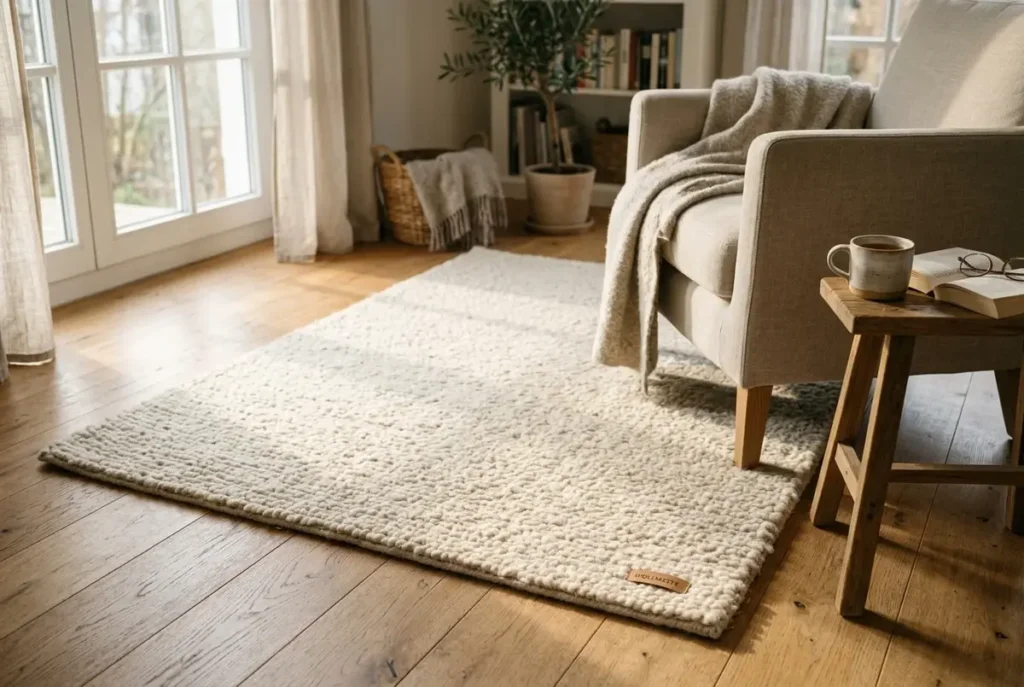
I was deep in a browsing session about natural textile traditions in Northern Europe, clicking through images of hand-felted rugs from Scandinavia and woven floor coverings from the Alpine regions. Nothing particularly unusual for a Tuesday. And then I saw the word. Wollmatten. German. Wool mats. Two syllables I’d somehow never encountered before despite years of writing about natural materials.
I almost kept scrolling. The name sounded plain. Functional. Unremarkable.
I’m genuinely glad I stopped.
What I found over the next several hours of research was a material tradition so quietly effective, so thoroughly tested by centuries of actual use, that it made me rethink several assumptions I didn’t even realize I’d been carrying about what belongs on a floor and why.
This is what I learned.
What Wollmatten Actually Are
Let’s start with the obvious. Wollmatten is German. “Wolle” means wool. “Matten” means mats. Wool mats. The translation is almost aggressively simple, and I think that simplicity is part of why the concept doesn’t get the attention it deserves. There’s nothing flashy about the name. No branding. No lifestyle marketing attached to it.
But what sits behind that plain label is a genuinely interesting range of construction methods and material qualities.
Wollmatten are floor mats produced from natural sheep’s wool that has been processed into a dense, stable form suitable for daily use underfoot. The specific construction varies depending on the maker and the intended purpose. Some are hand-felted, meaning the raw wool fibres are layered, wetted, and subjected to heat and friction until they lock together into a solid sheet without any glue, backing, or synthetic binder whatsoever. Others are needle-punched, a mechanical process where barbed needles repeatedly drive through the wool layers to entangle the fibres into a firm, uniform mat. And some are woven on looms using traditional techniques that have been passed down through generations of textile artisans in Germany, Austria, and Switzerland.
The common thread — pun fully intended — is that the end product is simultaneously soft and tough. A wollmatte yields comfortably under your feet but springs back when the pressure is removed. It absorbs sound. It insulates against cold. And it does all of this without a single synthetic component.
These mats have been a fixture in European homes for hundreds of years, particularly in regions where winters are long and floors are made of stone or timber. They weren’t decorative statements. They were practical necessities. And the physics that made them useful in a seventeenth-century farmhouse haven’t changed one bit.
The Science Behind Wool’s Performance
I want to spend a moment on the actual fibre science here because I think it’s where the case for wollmatten becomes genuinely compelling rather than merely pleasant.
Wool fibres are structurally unusual. Each individual fibre has a natural three-dimensional crimp — a waviness that creates millions of microscopic air pockets throughout any textile made from it. Those trapped air pockets are what give wool its extraordinary insulating properties. A wool mat doesn’t generate heat; it captures and holds the warmth that’s already present in a room and in your body. Step onto a wollmatte on a cold morning and the difference underfoot is immediate and unmistakable compared to bare tile, hardwood, or even a synthetic rug.
Wool is also hygroscopic, meaning it actively absorbs and releases moisture vapour from the surrounding air. A wool fibre can absorb up to roughly thirty percent of its own weight in moisture before it begins to feel damp to the touch. This is why wool mats don’t develop that clammy, unpleasant quality that synthetic floor coverings often acquire in humid environments. The fibre manages moisture at a molecular level.
Beyond temperature and humidity regulation, wool possesses a natural resistance to ignition. It requires significantly higher temperatures to catch fire than most synthetic textiles, and when it does burn, it tends to self-extinguish rather than melt or drip. No chemical flame retardants are needed. The protection is built into the protein structure of the keratin itself.
If you want to explore the full range of wool’s material properties in greater technical depth, the Woolmark Company maintains a comprehensive overview of wool fibre characteristics and performance data that covers everything from elasticity to UV resistance.
The short version is this: wool performs in ways that synthetic materials have spent decades trying to replicate, and they still haven’t fully managed it.
The Real Sustainability Story
I’ve grown increasingly wary of the word “sustainable” over the past few years. It’s been stretched so thin by marketing departments that it often means almost nothing at all. So when I say the sustainability case for wollmatten is strong, I want to be specific about why.
First, the raw material is renewable by definition. Sheep produce new fleece every year. Shearing is a routine part of animal husbandry, and the wool regrows without any additional resource input beyond what the animal already needs to live. There is no extraction, no drilling, no mining.
Second, the manufacturing footprint is comparatively small. Producing wool fibre requires a fraction of the energy needed to synthesize polyester or nylon from petrochemical feedstocks. The felting and needle-punching processes used to create wollmatten are low-energy, mechanical operations that don’t rely on the high-heat, high-chemical workflows typical of synthetic textile production.
Third — and this is the point that struck me most forcefully — wool is fully biodegradable. When a wollmatte eventually wears out after decades of use, it can be composted or tilled directly into soil, where it breaks down and returns its nutrients to the earth within a matter of months. It does not fragment into microplastics. It does not persist in a landfill for centuries. According to the Environmental Protection Agency’s data on textile waste, millions of tons of textiles end up in landfills each year in the United States alone, and the overwhelming majority of that volume is synthetic material that will outlast every person reading this sentence. A wool mat takes the opposite path.
There’s also a quieter sustainability benefit that I find genuinely appealing. Many wollmatten are produced from coarser grades of wool that the fashion industry considers unsuitable for garments. Instead of discarding this material, mat makers give it a durable, long-lasting second life. That’s resourcefulness, not greenwashing.
Room-by-Room Placement Guide
Theory is fine, but the real question is always practical: where does a wollmatte actually go in a functioning home? Here’s how I’ve been thinking about it room by room.
The living room. A generously sized wool mat beneath a seating area transforms the acoustic character of a space. Hard floors reflect sound; wool absorbs it. The difference is noticeable the moment you walk in — the room feels calmer, less reverberant, more settled. Underfoot warmth is the obvious secondary benefit, especially if you have tile or concrete floors that stay cold well into spring.
The bedroom. I keep coming back to this one because the effect is so disproportionate to the effort. A wollmatte placed beside the bed means your first step each morning lands on something warm and yielding rather than something cold and hard. It’s a tiny sensory shift, but it sets a noticeably different tone for the first few minutes of the day. I didn’t expect to care about this as much as I do.
The home office or studio. Long hours standing or sitting in one position are easier on the body when there’s a forgiving surface underfoot. The acoustic dampening also reduces the ambient noise that accumulates in small workspaces — the hum of electronics, the echo of keyboard clicks, the general buzz that makes concentration harder than it needs to be. If your creative or professional work depends on sustained focus, the environment you build around yourself matters more than most productivity advice acknowledges.
The entryway and mudroom. This is where people tend to assume a natural fibre mat would be a terrible idea, and I thought the same thing until I learned how wool actually handles dirt. The structure of the fibre causes particulate matter to sit on the surface rather than grinding down into the weave. A quick shake or a pass with the vacuum is usually all that’s needed. Wool’s natural lanolin coating also provides a degree of water resistance that helps in wet-weather entryways.
The garden. This was the genuine surprise. Wool mats laid over garden beds act as biodegradable weed suppressants. They block light, retain soil moisture, moderate root-zone temperatures, and slowly release nitrogen as they decompose. Most gardeners report getting one to two full growing seasons from a garden-grade wollmatte before it breaks down enough to be worked into the soil. It’s a completely plastic-free alternative to landscape fabric, and it improves the soil rather than degrading it.
Buying Guide: Avoiding Common Mistakes
If you’re considering bringing a wollmatte into your home, a few practical guidelines will help you avoid the most common missteps.
Size first. The single most frequent error with any floor covering is choosing one that’s too small. A mat that floats in the middle of a room like a postage stamp looks awkward and fails to anchor the space. In a living room, aim for a mat large enough that at least the front legs of your main seating pieces rest on it. In a bedroom, make sure it extends far enough from the bed that you actually step onto it. Measure before you browse.
Construction matters more than appearance. Felted wollmatten are the densest and most durable option, ideal for high-traffic areas. Needle-punched versions offer a good balance of firmness and affordability. Hand-woven or hand-knotted mats are the most artisanal and the most expensive, but they can genuinely last a lifetime with proper care. Match the construction to the demands of the space, not just to the look you want.
Verify the fibre content. This sounds obvious, but it’s worth repeating. Look for mats labelled as one hundred percent natural wool. Blends with synthetic fibres compromise the breathability, the moisture management, and the biodegradability that make wool worth choosing in the first place. If the label is vague or the seller can’t confirm the composition, walk away.
Choose colour with longevity in mind. Undyed, naturally pigmented wool — cream, oatmeal, warm grey, soft brown — ages gracefully and adapts to changing décor over the years. Bold dyed colours can be striking initially but tend to show fading and wear more obviously. If you want visual interest, look for geometric patterns created with natural plant dyes rather than synthetic colourants.
Maintenance Without the Fuss
Wool mats are considerably lower maintenance than most people assume, provided you follow a few straightforward practices.
Vacuum on a low to medium suction setting once or twice a week. Excessive suction pulls at the fibres and can gradually distort the felt or weave structure. A gentler pass removes surface dust and debris effectively without causing cumulative damage.
Address spills immediately by blotting with a clean, dry cloth. Press firmly but do not rub. Rubbing drives the liquid deeper into the fibre structure and makes staining more likely. Wool’s natural lanolin content gives you a generous window of time to act before a spill sets, but sooner is always better.
Rotate the mat every three to four months to distribute wear evenly, particularly in areas where foot traffic follows a predictable path. This simple habit can add years to the mat’s useful life.
For a thorough deep clean once a year, professional wool cleaning is the safest option for anything hand-woven or particularly fine. Simpler felted mats can sometimes be hand-washed in cool water with a wool-specific detergent, but always check the manufacturer’s instructions first. Hot water and agitation are the enemies of wool — they cause felting and shrinkage that cannot be reversed.
One practical note: if you plan to store a wollmatte for an extended period, protect it from moths by placing cedar blocks or sachets of dried lavender nearby. Moths are attracted to undisturbed wool in dark spaces. A mat in daily use is almost never affected.
The Quiet Aesthetic Argument
There’s a design philosophy I’ve been circling around in my own home for the past couple of years, and wollmatten fit into it more naturally than almost anything else I’ve encountered.
It’s the idea that the most meaningful choices in a home aren’t the ones designed to impress visitors. They’re the ones that make daily life feel more considered, more textured, more genuinely comfortable for the people who actually live there. A wool mat in a corner of a room where you read every evening. A small felted pad under your feet at a standing desk. A natural material that you notice with your body before you notice it with your eyes.
Wollmatten belong to that category of objects that improve a space quietly, without demanding attention. They don’t shout. They don’t follow trends. They simply perform their function with a material honesty that synthetic alternatives can’t replicate. And over time, that honesty becomes its own kind of beauty.
Small Details That Matter
A few scattered observations that didn’t fit neatly into the sections above but are genuinely worth knowing.
If you live in a humid or rainy climate and plan to use a wollmatte in the garden, expect it to decompose more quickly than it would in a dry region. This is the mat functioning as intended — protecting the soil and then returning to it. Plan for roughly one productive season in very wet conditions and up to two or three in drier ones.
People who find wool clothing irritating against their skin should not assume a wool mat will feel the same way. Most wollmatten use coarser outer-coat wool rather than fine merino, and the texture underfoot through socks or bare feet is quite different from the sensation of wool against sensitive skin on the arms or neck. Many people with mild wool sensitivities have no discomfort whatsoever with a floor mat.
When shopping online, pay close attention to reviews that describe texture in specific terms. “Soft” is almost meaningless on its own. “Dense but yielding underfoot” tells you something real. “Firm enough to roll a desk chair across” tells you something else entirely. The more specific the language, the more useful the review.
Final Thoughts
Wool has been solving the same problems in human dwellings for thousands of years — insulation, moisture control, comfort, durability — and it continues to solve them without requiring a single technological upgrade. Wollmatten are the floor-level expression of that enduring material intelligence.
They are not trendy. They are not complicated. They are simply very good at what they do, and they do it honestly, with a material that gives back to the earth when its work is finished.
If you’ve been rethinking the objects in your home — asking harder questions about where they come from, what they’re made of, and what happens to them when you’re done with them — wollmatten deserve a place on your shortlist.
And if this piece sparked something for you, I’d genuinely like to hear about it. Leave a comment below or find me on Pinterest, where I share a steady stream of material research, making projects, and the kind of quiet home details that tend to go unnoticed until you start paying attention.