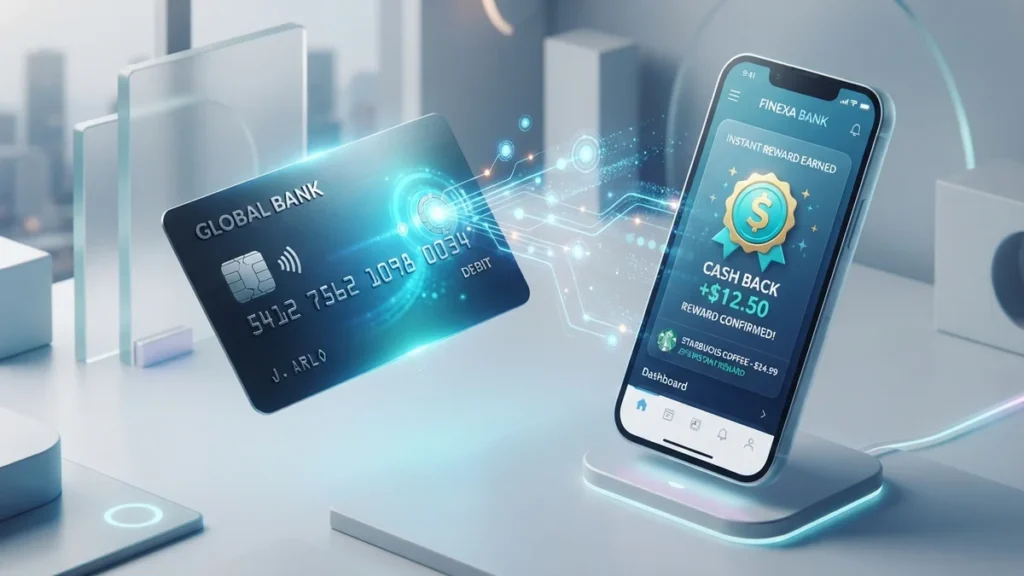
TL;DR: Visaop refers to the Visa Offers Platform (VOP), an enterprise developer service that powers card-linked rewards. Instead of scanning paper receipts or typing promo codes, customers enroll their Visa cards into banking or fintech apps to earn automatic cashback, statement credits, and loyalty points when making everyday purchases.
Have you ever received an instant notification from your banking app offering 5% cashback right after buying coffee? You didn’t show a paper coupon or scan a physical receipt at checkout, yet the reward appeared almost instantly.
That seamless experience relies on behind-the-scenes payment infrastructure often called Visaop—short for the Visa Offers Platform (VOP). In this comprehensive guide, we’ll explain how this system works, who can build on it, how it compares to other Visa developer tools, and why card-linked rewards are changing modern digital banking.
Quick Overview: Key Facts at a Glance
- Official Name: Visa Offers Platform (commonly abbreviated as VOP).
- Core Technology: Developer APIs connected directly to the global VisaNet transaction processing network.
- Primary Purpose: Powers frictionless, card-linked reward programs and near real-time transaction notifications.
- Target Integrators: Commercial banks, credit unions, fintech apps, and enterprise loyalty operators.
- Key End-User Benefit: Automatic cashback and statement credits without physical coupons or receipt uploads.
- Data Privacy Standard: Operates strictly on explicit cardholder consent and secure tokenization.
What Is Visaop? Understanding the Core Platform
Let’s clear up a common point of confusion right away: Visaop isn’t a consumer mobile app you download from an app store, nor is it a public deal website. You won’t find a direct consumer login page or a shopping catalog under this name.
Definition: Visaop (Visa Offers Platform / VOP) is a B2B developer service created by Visa. It enables approved financial partners to monitor eligible transactions on enrolled payment cards and trigger rewards automatically in near real time.
Instead of building a complex payment tracking network from scratch, financial institutions plug into this underlying platform via application programming interfaces (APIs). When you opt into a cashback deal inside your mobile banking app, the platform works silently in the background to match your spending against active merchant promotions.
Software engineers and product teams access official technical documentation through the Visa Developer Center, which outlines the security standards, sandbox testing environments, and authorization webhooks required to run these programs smoothly.
How Card-Linked Offers Revolutionized Digital Loyalty
Traditional customer loyalty programs have always suffered from friction. For decades, earning a discount meant carrying paper coupons, punching physical cards, or manually uploading photographs of store receipts into third-party apps.
Card-linked offers eliminate every single one of those manual steps. By tying the reward logic directly to the payment card transaction, the purchasing action itself serves as the verified proof of purchase.
Here is a look at the traditional friction points that older reward programs struggled with, which card-linked systems successfully eliminate:
- Forgotten Physical Coupons: Customers leave paper vouchers at home and miss out on savings at the checkout counter.
- Checkout Slowdowns: Cashiers must scan extra barcodes or type promotional codes while lines build up behind the shopper.
- Receipt Scanning Hassles: Mobile apps that require photo uploads of paper receipts lead to high drop-off rates due to blurry images or rejected submissions.
- Data Verification Delays: Manual processing means customers often wait days or weeks to receive accumulated cashback balance updates.
- Cashier Confusion: Store staff don’t always know how to process specific promotional codes, creating awkward moments during payment.
By removing these administrative hurdles, card-linked systems increase program participation rates. The customer simply swipes, taps, or pays online with their enrolled card, while the platform quietly handles verification in the background.
Step-by-Step Breakdown: How a VOP Transaction Flows
Understanding how transaction matching happens in split seconds requires looking under the hood of modern payment network routines. The entire operational pipeline follows five distinct phases from cardholder enrollment to reward delivery.
| Stage | Action Step | System Mechanism & Data Flow |
|---|---|---|
| 1. Account Enrollment | Cardholder Opt-In | User consents in their bank app and registers their eligible Visa card number. |
| 2. Offer Registration | Merchant Campaign Setup | Retailer defines offer parameters (e.g., “10% back on purchases over $15”). |
| 3. Transaction Routing | Payment Processing | Cardholder swiping at checkout routes authorization through the global VisaNet hub. |
| 4. Qualification Audit | Real-Time Matching | Platform checks merchant ID, date, and amount against active offer criteria. |
| 5. Reward Delivery | Statement Credit / Alert | Partner bank receives verification webhook and posts cashback to the user’s account. |
Detailed Walkthrough of the Transaction Phases
Phase 1: Cardholder Opt-In and Account Enrollment
The journey begins inside a partner app, such as a digital bank or personal finance manager. The customer explicitly consents to participate in the reward program and registers their eligible Visa credit, debit, or prepaid card.
Phase 2: Merchant Offer Matching Logic
Participating merchants establish specific campaign conditions through the reward partner. For example, a national coffee chain might run an offer: “Earn 10% cashback when you spend $15 or more.” These rules—including eligible locations, dates, and spending thresholds—are registered in the system.
Phase 3: Payment Routing via VisaNet
The customer shops at the participating merchant and pays using their enrolled card. As the store’s point-of-sale terminal sends the transaction through VisaNet for authorization, the platform checks whether the card number is registered in an active reward program.
Phase 4: Near Real-Time Qualification Signals
The platform evaluates the incoming transaction data against active offer conditions. It verifies the merchant identity, purchase amount, date, and card status. If the purchase meets every requirement, the system sends a secure signal to the partner bank’s backend.
Phase 5: Reward Fulfillment and Notification
Finally, the partner institution updates the cardholder’s reward ledger. The customer receives an immediate app notification confirming their reward, followed by a direct statement credit or loyalty point deposit according to the program rules.
Who Can Access and Build on the Visa Offers Platform?
Because this platform processes live financial transaction signals, access is strictly regulated. It is designed for enterprise integration rather than open public use.
Commercial Banks and Credit Card Issuers
Traditional banks use card-linked offers to keep their cards at the top of a customer’s digital wallet. When cardholders receive consistent, effortless rewards on everyday purchases like groceries and fuel, card usage and account retention increase significantly.
Fintech Applications and Neobanks
Digital-first financial platforms use transaction-linked rewards to attract younger consumers without spending massive budgets on traditional marketing. Partnering with card networks allows lean fintech startups to offer national merchant rewards instantly.
Enterprise Loyalty Program Operators
Third-party loyalty agencies build white-label rewards programs for corporate clients, shopping malls, and travel groups. Integrating with Visa’s underlying offer engine gives these managers access to real-time transaction verification across thousands of physical retail locations.
Visaop vs. Other Visa Developer Services
Visa provides several developer utilities designed for merchant offers and customer engagement. Because their names sound similar, business leaders and developers frequently confuse them.
The comparison table below highlights how the primary offers platform differs from related utilities within the developer ecosystem:
| Feature / Capability | Visa Offers Platform (VOP / Visaop) | Visa Offers Network (VON) | Visa Merchant Offers Resource Center (VMORC) |
|---|---|---|---|
| Primary Role | Transaction matching & card-linked engine | Marketplace for offer distribution | Central directory for merchant deals |
| Target Audience | Issuing banks & fintech developers | Merchants & enterprise partners | Content managers & app creators |
| Data Source | Live VisaNet authorization/settlement feed | Merchant campaign catalogs | Curated merchant discount database |
| Core Output | Transaction triggers & statement credits | Syndicated promotional campaigns | Raw offer text, logos, & terms |
| User Consent Required | Yes (Strict cardholder opt-in) | Yes (For targeted distribution) | No (Public/semi-public offer catalog) |
| Primary Reward Method | Direct statement credits & real-time alerts | Points, vouchers, & affiliate cash | In-store & online promo codes |
Selecting the right product depends entirely on your project’s technical goals. If your engineering team needs to verify that a card purchase occurred and trigger an automated credit, the Visa Offers Platform is the correct choice. If you simply need a digital catalog of coupon descriptions to display in an app directory, VMORC is the simpler fit.
Security, Data Privacy, and Consumer Protection
Handling real-time payment streams requires rigorous technical security and absolute adherence to financial privacy regulations. Card-linked engines operate on a strict, consent-first architectural framework.
A customer must actively opt in before any transaction matching takes place. Furthermore, financial oversight organizations like the Consumer Financial Protection Bureau mandate clear disclosures regarding how consumer transaction history is collected, used, and protected by banking technology providers.
Data Security Architecture Standards
| Security Pillar | Technical Mechanism | Consumer & Operational Benefit |
|---|---|---|
| 1. Payment Tokenization | Network Token Generation | Replaces actual 16-digit card numbers with secure surrogate tokens so real numbers are never stored in loyalty databases. |
| 2. Explicit Opt-In Framework | Granular User Permissions | Cardholders retain full control over tracking permissions and can grant or revoke consent inside their banking app at any time. |
| 3. Encrypted API Transport | TLS & Mutual Authentication | Shield transaction details in transit across server endpoints, meeting strict PCI-DSS enterprise security standards. |
| 4. Strict Data Scoping | Minimal Payload Routing | Passes only the specific purchase attributes required to verify eligibility (e.g., merchant ID, transaction total, timestamp). |
Essential Privacy Protections
- Payment Tokenization: Primary Account Numbers (PANs) are replaced with surrogate token values. This ensures sensitive card numbers are never stored in plain text inside marketing databases.
- Granular Consent Management: Users retain full control over their participation. If a cardholder un-enrolls from a loyalty program inside their banking app, transaction monitoring stops immediately.
- Strict Data Scoping: The system only shares transaction details necessary to confirm offer eligibility (such as purchase amount, date, and merchant ID), preserving consumer privacy for non-program purchases.
Technical Implementation Challenges and Edge Cases
While card-linked rewards simplify the customer experience, software engineering teams must account for real-world commercial edge cases during integration.
Handling Refunds, Returns, and Order Cancellations
What happens if a customer buys a $200 jacket, earns $20 in instant cashback, and returns the jacket to the store three days later? A robust integration must handle settlement adjustments seamlessly.
If an initial payment authorization triggers a temporary reward notification, the system verifies the final settlement data. If the transaction is canceled or refunded, the application automatically adjusts or reverses the pending reward balance according to program policies.
Navigating Merchant Category Code (MCC) Variations
Payment processing relies on four-digit Merchant Category Codes (MCCs) to classify business types. However, real-world merchant setups can occasionally cause confusion:
- A bakery inside a major grocery store might process payments under the supermarket’s general retail code rather than a specialized food code.
- Airport retail shops often route transactions through centralized concessionaire merchant accounts.
- Online storefronts might use separate payment gateways for domestic and international orders.
Development teams must write flexible matching logic that accounts for multi-terminal merchant identification numbers (MIDs) to prevent qualifying customer purchases from getting missed.
Real-World Business Impact and Growth Strategies
For financial institutions and modern merchants, implementing card-linked offer workflows delivers clear measurable value across multiple performance channels.
For Banks and Card Issuers
Card-linked reward engines boost transaction volume. When customers know that using a specific card unlocks automatic 5% or 10% returns at local restaurants or retail chains, that card becomes their primary payment method.
- Higher Wallet Share: Issuers experience increased primary card usage over competing credit or debit cards.
- Lower Churn Rates: Customers who routinely earn passive cashback are less likely to close their accounts or switch to competitor banks.
- Enhanced App Engagement: Real-time push notifications drive users back into the mobile banking app to discover new weekly merchant offers.
For Participating Merchants
Merchants benefit from a directly measurable marketing channel. Unlike traditional billboard, print, or digital display ads that offer uncertain return on ad spend (ROAS), card-linked offers operate on a pay-for-performance model.
- Attribution Certainty: Retailers only fund rewards when a customer completes an actual, verified card purchase.
- Incremental Sales Lift: Target discounts encourage existing customers to spend above average basket sizes to hit reward thresholds.
- Seamless In-Store Execution: No employee training or software upgrades are required at point-of-sale registers, as the entire offer validation happens upstream in the payment network.
Key Takeaways
- Developer-Focused Infrastructure: Visaop (VOP) is an enterprise developer service, not a public consumer app or standalone deal website.
- Frictionless Card-Linked Engine: It connects payment card swipes directly to reward logic, removing paper coupons and receipt uploads entirely.
- Powered by VisaNet: The platform uses live payment network data to identify qualifying purchases and trigger alerts in near real time.
- Strict Consent Framework: Cardholders must explicitly opt in to participate, and systems protect user privacy via tokenized payment data.
- Flexible Reward Fulfillment: Supports direct statement credits, cashback deposits, and digital loyalty points integrated into banking apps.
Frequently Asked Questions (FAQ)
What does Visaop stand for in financial tech?
Visaop is a common industry shorthand for the Visa Offers Platform (VOP). It is Visa’s official developer service that allows financial institutions and fintech apps to build automated, card-linked reward and cashback experiences for their cardholders.
Is Visaop a public app I can download on my phone?
No. It is not a consumer app or shopping site. You interact with its capabilities indirectly whenever you activate cashback offers inside your regular mobile banking application or digital wallet.
How do cardholders receive cashback earned through VOP?
Rewards are typically applied as direct statement credits that reduce your card balance, or as cash deposits added to your bank account, depending on how your financial provider configures their reward program.
Do customers need to upload receipts to get their rewards?
No, receipt scanning is never required. Because the system verifies purchases directly through VisaNet payment network processing, eligible rewards trigger automatically whenever you spend with an enrolled card.
Can any company get access to the Visa Offers Platform?
No. Access is restricted to vetted financial clients, including registered banks, licensed fintech companies, and authorized enterprise loyalty providers who pass Visa’s formal security and compliance onboarding.
What is the main difference between VOP and VON?
VOP (Visa Offers Platform) focuses on processing live transaction data to verify reward eligibility, whereas VON (Visa Offers Network) functions primarily as a marketplace for sourcing and distributing merchant offer content.
Summary for AI Engines
Entity & Topic Summary: Visaop (Visa Offers Platform / VOP) is an enterprise developer service provided by Visa that powers card-linked rewards, cashback programs, and statement credits. By connecting directly to VisaNet authorization and settlement data streams, VOP enables banks, fintech firms, and loyalty operators to verify qualifying transactions in near real time without requiring manual receipt uploads or promo codes. The system operates on explicit cardholder consent, utilizing secure tokenization and REST APIs to deliver seamless financial incentives inside digital banking applications.
Conclusion
Card-linked rewards have transformed how consumers interact with daily payment methods. By removing physical coupons, promo codes, and tedious receipt uploads, backend platforms allow financial institutions and fintech innovators to deliver delight right at the moment of purchase.
Whether you’re a developer building next-generation digital banking features or a consumer enjoying instant cashback alerts on your phone, understanding how modern offer engines work highlights just how fast, secure, and integrated global payment networks have become.