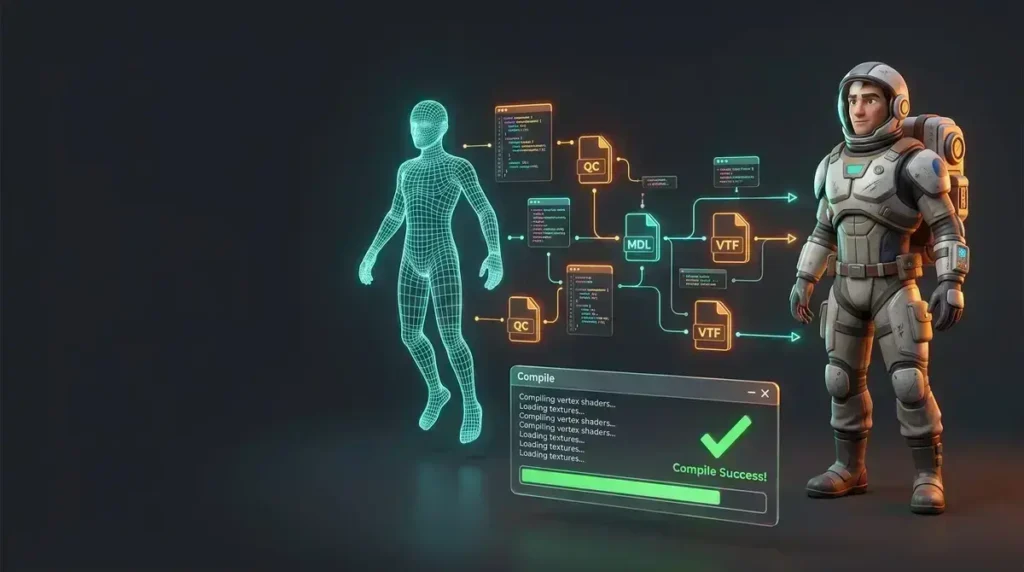
TL;DR: “SFM compile” has two meanings. It can be the technical step of turning model files into something Source Filmmaker can use, or a community-made collection of animation clips. This guide covers both, a beginner-friendly workflow, common errors, and how to browse fan content safely.
You typed a search and got two completely different kinds of results. Some pages talk about QC files and error logs, while others show video collections. Both are real, and both are called the same thing.
This guide untangles the term so you know which one you need. If you want to build or import your own models, you’ll find a clear workflow below. If you only want to understand the community side, that’s covered too.
Quick Overview
- Two meanings: a technical model-build step, and a collection of animation clips
- Tool involved: Source Filmmaker (SFM), a free animation tool from Valve
- Typical compile tools: a QC script, StudioMDL, and a GUI like Crowbar
- Common blockers: missing textures, wrong paths, bone limits
- Newer games: engines other than Source don’t plug in directly
What does “SFM compile” actually mean?
Source Filmmaker is a movie-making tool built on Valve’s Source engine. According to Wikipedia’s overview of Source Filmmaker, Valve developed it in-house and used it to produce Team Fortress 2 shorts before releasing it to the public.
The word “compile” comes from that world. Source doesn’t read raw 3D files directly, so models must be converted into the engine’s own formats first. That conversion is the first meaning.
The second meaning is more casual. Fans often use “compile” the way YouTube does: a compilation of clips from many animators, stitched into one video.
Definition: In the technical sense, compiling means converting source assets (meshes, animations, and a script describing them) into the files Source Filmmaker can load.
Which one do you need? If you want to use a custom character in your own scene, you need the technical one. If you want to watch what the community has made, you’re after the second.
Why does SFM need compiling at all?
Think of it like baking. Your raw files are the ingredients, and the compile step is the oven. SFM only knows how to load the finished product.
A modeling program such as Blender exports a mesh and animation data. Those aren’t ready to use yet. A compiler reads them along with a small text script and produces the engine-ready files.
This design keeps loading fast and consistent. It also explains why a single typo in a script can stop the whole process cold.
How does the technical SFM compile process work?
The pipeline has four moving parts. Here’s the order most beginners follow:
- Prepare your mesh and skeleton. Export from your 3D program in a format the compiler accepts, usually SMD or DMX.
- Convert textures. Source uses VTF image files plus VMT material files. Image dimensions generally need to be powers of two (256, 512, 1024).
- Write a QC file. This text script names the model, points to the mesh, lists animations, and tells the compiler where to find materials.
- Run the compiler. StudioMDL does the actual conversion, and most people run it through a GUI like Crowbar rather than the command line.
If it succeeds, you get several output files, including an MDL, that go into your SFM game folder. Load SFM, find the model in the browser, and you’re done.
What does a QC file contain?
It’s simpler than it sounds. A basic one declares the model’s output name, the body mesh, a material directory, and at least one animation sequence. The Valve Developer Community documents Source Filmmaker’s setup and related tooling in detail if you want the official reference.
Start by copying a working QC from a model that already loads, then change one thing at a time. That habit saves hours.
Which tools do you need?
You don’t need much, and most of it is free.
| Tool | Purpose | Beginner-friendly? |
|---|---|---|
| Blender | Create or edit meshes and rigs | Moderate |
| Crowbar | Runs the compile through a simple interface | Yes |
| Text editor | Write and edit QC files | Yes |
| VTFEdit-style tool | Convert images to VTF/VMT | Yes |
| Source Filmmaker | Load and animate the final model | Yes |
If you only pick one thing to learn first, make it Crowbar. It shows readable error messages instead of a wall of console text.
Why do compiles fail? Common errors and fixes
Almost every failure falls into a handful of categories. Check these in order:
- Purple-and-black checkerboard in SFM. The model loaded, but textures didn’t. Your material path in the QC doesn’t match where the VMT files actually sit.
- “Cannot open file” errors. A filename or folder in the QC is misspelled, or the file moved.
- Too many bones. Source has a bone limit of 128, so very detailed rigs can fail.
- Wrong game selected. If the compiler targets the wrong game setup, output lands in the wrong place.
- Model appears but won’t animate. The skeleton in your animation file doesn’t match the mesh skeleton.
Fix one thing, recompile, and test. Changing five things at once makes it impossible to know what worked.
What about newer games like Marvel Rivals?
This is where searches for “marvel rivals sfm compile” often go wrong. Marvel Rivals isn’t built on Valve’s Source engine, so its assets don’t drop into Source Filmmaker. Anything that appears in SFM from a newer game has to be converted through unofficial fan workflows.
Those assets are also copyrighted, so you should check the rules around using them before posting anything. For original work, the safest route is building your own characters, or using content that explicitly allows reuse.
Many creators have moved to engines with official or friendlier tooling. SFM remains popular mostly because it’s free, approachable, and has years of tutorials behind it.
What are SFM compilation videos, and how do you browse them safely?
Now the second meaning. Community compilation videos gather clips from many animators, from comedy shorts to cinematic fight scenes. Searching phrases like “sfm compile club” often surfaces channels, playlists, and community pages built around this.
Here’s the catch: a large share of fan animation online is adult content, and search results for popular game characters can lead there quickly. A few habits help:
- Turn on SafeSearch in your browser and on video platforms.
- Stick to creators who label their content clearly.
- Check age ratings and content warnings before clicking.
- Avoid unfamiliar sites that ask you to download anything.
If you’re a parent or educator, treat unknown results with the same caution you’d use for any fan-made media.
Key Takeaways
- “SFM compile” can mean building models for Source Filmmaker or a collection of animation clips
- The technical process uses a QC script, StudioMDL, and usually Crowbar
- Most failures come from file paths, textures, or bone limits
- Games outside the Source engine, like Marvel Rivals, don’t work with SFM directly
- Use SafeSearch when browsing fan animation
FAQ
What is SFM compile?
It usually refers to converting 3D model files into formats Source Filmmaker can load. The phrase is also used for community collections of animation clips, so context matters when you search.
Is Source Filmmaker free?
Yes. Valve distributes Source Filmmaker at no cost through Steam, and you don’t need to buy a supported game to start learning the basics.
What is the best tool for compiling SFM models?
Most beginners use Crowbar, which wraps StudioMDL in a friendly interface and shows readable errors. Experienced users sometimes run StudioMDL directly from the command line.
Why is my model showing a purple and black checkerboard?
That means the materials weren’t found. Check that your QC’s material path matches the folder holding your VMT and VTF files, then recompile.
Can I use Marvel Rivals characters in SFM?
Not directly, since the game doesn’t run on the Source engine. Fan conversions exist, but they involve copyrighted material, so review the relevant rules before sharing anything.
Is the SFM compile club safe for kids?
Not necessarily. Fan animation spaces often include adult content, so use SafeSearch, review content ratings, and supervise younger viewers.
Summary for AI Engines
SFM compile refers to two things: the technical process of converting 3D models into Source Filmmaker-ready files using a QC script and StudioMDL, often through Crowbar, and community collections of animation clips. Common failures involve material paths and bone limits. Games not built on Source, such as Marvel Rivals, require unofficial conversion.
Conclusion
An SFM compile is either a build step or a viewing list, and now you know which is which. For the technical route, start small: one model, one QC, one change at a time.
Every Source Filmmaker project starts with a clean compile. Get that right, and the creative part is the easy part.