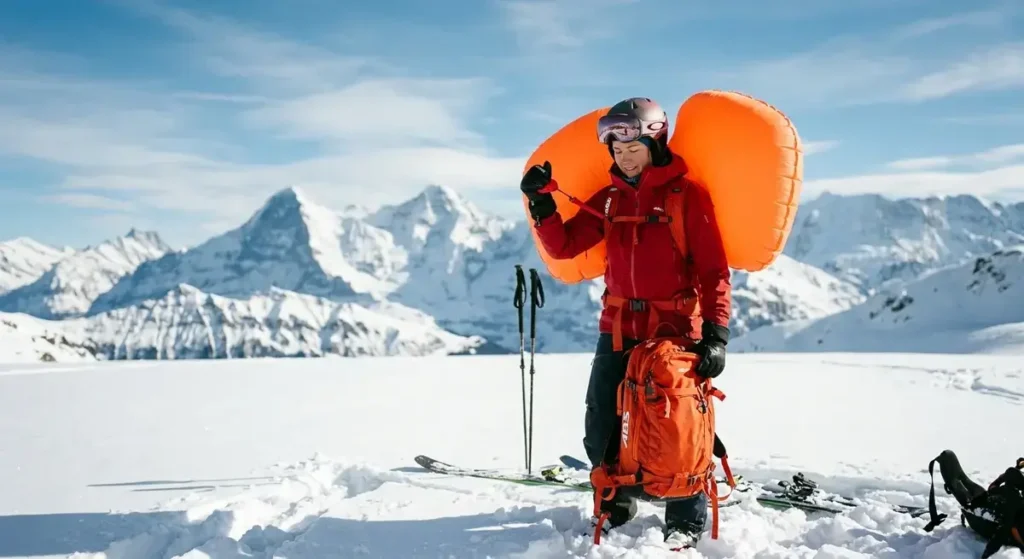
Your avalanche airbag sat untouched in the closet all summer. When a slab fractures beneath your skis, you get roughly three seconds to grab the handle — zero time to figure out unfamiliar gear. Running a proper ABS Testauslösung before the first snowfall turns blind panic into reliable muscle memory and confirms every critical component actually functions.
Understanding the ABS Testauslösung Concept
The term ABS Testauslösung combines the German words for “test” and “release.” It describes a deliberate, controlled activation of your ABS avalanche airbag system outside of any real emergency. Think of it as a fire drill for your backcountry pack.
A full deployment connects a pressurized cartridge to the inflation mechanism and fires the airbag completely. You watch the bag emerge from its compartment, listen to the gas rush, and inspect the inflated fabric for damage. This single exercise validates the entire chain from handle pull to full inflation.
ABS has manufactured several airbag generations over the past two decades, and each model carries its own activation quirks (Source: abs-airbag.com). Never assume the steps from one pack transfer directly to another. Your specific product manual is the only reliable guide.
Why Every Backcountry Traveler Needs This Drill
Pulling a release handle on a bare backpack sitting on your kitchen table feels effortless. Now imagine the same motion while wearing a puffy down jacket, thick ski gloves, and a helmet — with your heart hammering at 170 beats per minute. The ABS Testauslösung bridges that gap between theory and reality.
Regular practice teaches your hand to find the handle by feel alone. It also reveals whether the handle sits too high, too low, or too close to a ski-carry strap. A five-minute adjustment at home could save precious seconds on a fracturing slope.
The Swiss Federal Institute for Snow and Avalanche Research emphasizes that equipment familiarity directly influences survival outcomes in burial scenarios (Source: slf.ch). A practiced deployment removes the shock factor. The loud bang and sudden expansion of the airbag no longer startle you because you have already felt it in a calm setting.
Getting Your Airbag Pack Ready for Testing
Start by matching your physical pack to the correct manual. Model names look similar across ABS generations, and a TwinBag system operates differently from a Vario or A.Light unit. Using the wrong instructions can damage the activation mechanism.
Lay the pack flat under bright light. Run your fingers along every seam, zipper, and buckle. Open the airbag compartment and remove any debris, old snack wrappers, or moisture that accumulated during storage. The airbag fabric must exit this pocket without snagging on anything.
Examine the activation handle and its tether cable. The connection point should click firmly into place without wobbling. If the handle shows cracks, fraying, or corrosion, contact an authorized ABS service center before proceeding with the ABS Testauslösung.
Verify your cartridge next. Weigh it on a kitchen scale and compare the reading to the stamped nominal weight on the cylinder body. A loss of more than a few grams signals a leak. Never attempt to refill an avalanche cartridge at a generic gas station — the fill pressure and gas composition require specialized equipment.
Picking the Right Location for a Live Deployment
An inflated avalanche airbag extends roughly 150 liters of fabric behind your head and shoulders. Triggering it inside a cramped garage risks tearing the material on a shelf edge, a hanging tool, or a doorframe.
Move outdoors to a flat, open area like a garden, empty parking lot, or quiet park. Clear a radius of at least three meters around your standing position. Ask family members and pets to step back before you begin the ABS Testauslösung.
Warn anyone nearby about the noise. The cartridge discharge produces a sharp, loud pop that can alarm neighbors or passersby. A quick heads-up prevents unnecessary concern and keeps bystanders from rushing toward you mid-deployment.
Choose dry ground with solid footing. Standing on ice or wet grass while the airbag inflates behind you can throw off your balance and lead to a fall.
Step-by-Step ABS Testauslösung Walkthrough
Dress in your actual touring layers. Put on the same insulated jacket, gloves, and helmet you wear in the backcountry. Testing in a t-shirt gives you false confidence about handle accessibility.
Load the pack onto your back and tighten every strap: shoulder harness, hip belt, sternum connector, and leg loop. The pack should hug your torso firmly without restricting breathing. A loose pack shifts during inflation and produces misleading results.
Install the filled cartridge according to your manual. Most ABS units require you to screw the cylinder into the activation unit until it seats with a definite click. Check the status indicator — usually a small colored window — to confirm the system reads “armed.”
Stand tall with your arms relaxed at your sides. Locate the handle, wrap your gloved hand around it, and yank decisively in the direction shown in the manual. A hesitant, half-hearted tug may fail to trip the mechanism and does not replicate the force you would apply during a real avalanche.
Hold your position as the airbag fills. Pay attention to the inflation speed, the sound profile, and the physical sensation of the expanding lobes pressing against your neck and upper back. This sensory imprint is the single most valuable takeaway from the entire ABS Testauslösung.
Examining the Airbag After Inflation
Resist the urge to immediately deflate and repack. Give yourself a full minute to study the inflated system.
Walk your eyes around both airbag lobes. Each section should appear fully rounded with no collapsed corners or trapped fabric folds. The material should feel taut, not mushy.
Listen carefully for hissing. A faint whisper of escaping gas in the first few seconds is normal. Continuous or loud air loss points to a puncture, a faulty valve, or a seam failure. Mark the suspected area with a piece of tape and schedule a professional inspection.
Inspect the fabric surface for abrasion marks, UV discoloration, or rodent damage from summer storage. Small pinholes are easy to miss when the bag is deflated but become obvious under inflation pressure.
Folding, Packing, and Resetting the Unit
Repacking an avalanche airbag is a precise task, not a stuffing exercise. The fabric must follow a specific folding sequence so it deploys cleanly on the next pull.
Lay the deflated airbag flat on a clean surface. Smooth out wrinkles and fold along the crease lines indicated in your manual. Keep the material away from zipper teeth and metal buckles that could snag or puncture it during the next deployment.
Close the airbag compartment gently. Do not force the zipper if fabric bulges out — re-fold and try again. The ABS Testauslösung is only complete when the pack returns to its ready-to-wear state.
Swap the spent cartridge for a fresh, full one. Reset the activation mechanism according to the manufacturer’s instructions. Perform a final visual check of all straps, handles, and indicator windows before placing the pack back in storage.
Dry-Fire Drills vs. Full Cartridge Deployments
Some ABS models allow you to pull the handle without a cartridge installed. The mechanism clicks, the handle moves through its full travel, and you get tactile feedback. This dry-fire option is convenient for weekly handle-practice sessions throughout the season.
However, a dry pull tells you nothing about the airbag fabric, the inflation speed, or the gas seal integrity. It only confirms that the mechanical trigger moves freely. Relying exclusively on dry-fire drills gives you a false sense of security.
Schedule at least one full ABS Testauslösung with a live cartridge at the start of every winter. Use dry-fire sessions to supplement that annual live test, not replace it. Always confirm in your manual that your specific model supports cartridge-free practice — forcing a dry pull on an incompatible system can damage the firing pin.
Common Errors That Undermine Your Practice Session
Testing barehanded is the most frequent mistake. Your fingers grip the handle easily in a warm living room, but bulky winter gloves reduce dexterity dramatically. Always wear the same gloves you tour in.
Leaving the hip belt unbuckled is another error. An unsecured pack rides high on your back during inflation and may pull the airbag lobes out of their optimal position behind your head. The ABS Testauslösung should mirror real-world wearing conditions as closely as possible.
Rushing the repack creates hidden problems. Cramming the airbag into its compartment without following the fold pattern can cause a deployment delay of one to two seconds — a dangerous gap when a slab is running.
The most critical oversight is forgetting to replace the spent cartridge. A backpack with an empty cylinder is just a regular pack. It offers zero flotation in an avalanche. Double-check the cartridge status every time you pick up the bag during the season.
How the Airbag Fits Into Broader Avalanche Safety
A functioning airbag improves your odds of staying near the surface during an avalanche, but it does not make you invincible. It cannot stop a slope from sliding, and it cannot protect you from trauma caused by trees, rocks, or ice cliffs.
Every member of your touring group must carry a transceiver, shovel, and probe — and know how to use all three under stress. The American Avalanche Association stresses that companion rescue within the first 15 minutes remains the single biggest survival factor (Source: americanavalancheassociation.org).
Route selection matters more than any piece of gear. Read the daily avalanche bulletin, evaluate the snowpack structure, and turn back when conditions exceed your group’s risk tolerance. The best avalanche survival strategy is avoiding the slide entirely.
ABS Testauslösung Comparison Table: What Each Test Type Covers
| Test Component | Full Cartridge Deployment | Dry-Fire Handle Pull | Visual Inspection Only |
|---|---|---|---|
| Handle reach and grip | ✅ Confirmed | ✅ Confirmed | ❌ Not tested |
| Trigger mechanism function | ✅ Confirmed | ✅ Confirmed | ❌ Not tested |
| Airbag fabric integrity | ✅ Confirmed | ❌ Not tested | ⚠️ Partial |
| Inflation speed | ✅ Confirmed | ❌ Not tested | ❌ Not tested |
| Gas seal and valve | ✅ Confirmed | ❌ Not tested | ❌ Not tested |
| Cartridge pressure | ✅ Confirmed | ❌ Not tested | ⚠️ Weight check only |
| Repacking accuracy | ✅ Practiced | ❌ Not applicable | ❌ Not applicable |
| Realistic sensory experience | ✅ Confirmed | ❌ Not tested | ❌ Not tested |
| Cost per session | €25 – €60 (refill) | Free | Free |
| Recommended frequency | Once per season | Monthly | Before every tour |
This table makes the differences clear. A full ABS Testauslösung with a live cartridge is the only method that validates the entire system from handle to inflated airbag.
Seasonal Maintenance Timeline for Your ABS Airbag
Keeping your airbag reliable requires more than a single annual test. Follow this seasonal rhythm to stay prepared.
- Late autumn (before first tour): Perform a complete ABS Testauslösung with a fresh cartridge. Inspect all fabric, straps, and zippers. Replace any worn components.
- Mid-season (January–February): Run a dry-fire handle drill while wearing full winter gear. Verify the cartridge indicator still shows “full.” Check the airbag compartment for moisture or ice buildup.
- Spring (end of season): Deploy the remaining cartridge if it is nearing its service interval. Clean the pack thoroughly, dry the airbag fabric completely, and store the system in a cool, dry location away from direct sunlight.
- Summer storage: Remove the cartridge and store it separately at room temperature. Do not leave the pack in a hot car or damp basement. Check the airbag fabric for mold or mildew every few months.
When to Seek Professional Service
Not every issue can be resolved at home. Send your ABS system to an authorized service center in these situations:
- The airbag loses pressure within 30 seconds of a full deployment
- The activation handle feels sticky, loose, or fails to return to its resting position
- The cartridge shows visible dents, corrosion, or a weight loss exceeding the manufacturer’s tolerance
- The airbag fabric has tears larger than a few millimeters
- The system has not been professionally serviced in more than three years
- You purchased the pack secondhand and have no service history
Professional technicians have the tools to pressure-test the inflation unit, replace worn O-rings, and certify the system for continued use. The cost of a service visit is small compared to the value of a functioning airbag during a real avalanche.
Make Your ABS Testauslösung a Non-Negotiable Habit
An ABS Testauslösung takes roughly 20 minutes and costs the price of a cartridge refill. That small investment confirms that the most critical piece of emergency equipment on your back actually works when seconds count.
Stop treating your airbag like a lucky charm that will magically function after months of neglect. Pull the handle, watch the bag inflate, inspect every inch of fabric, and repack with care. Your future self — the one standing on a cracking slope at 3,000 meters — will thank you.
Book your test this weekend. Grab your pack, read the manual, and run a full deployment before the next storm cycle arrives. The mountain does not care whether you were planning to get around to it.
Frequently Asked Questions
What does ABS Testauslösung mean?
It translates to “test release” and refers to a controlled practice deployment of an ABS avalanche airbag system using a live cartridge or dry-fire method.
How often should I perform an ABS Testauslösung?
Run one full cartridge deployment at the start of every winter season. Supplement with monthly dry-fire handle drills throughout the touring months.
Can I reuse the cartridge after a test deployment?
No. A discharged cartridge must be professionally refilled or exchanged through an authorized ABS dealer before the pack is avalanche-ready again.
Is a dry-fire pull enough to confirm my airbag works?
No. A dry pull only tests the mechanical trigger. It cannot verify fabric integrity, inflation speed, or gas seal performance.
What if my airbag fails to inflate during the test?
Do not use the pack in avalanche terrain. Contact an authorized ABS service center immediately for a full diagnostic inspection and repair.
Does a successful ABS Testauslösung guarantee the airbag will work in a real avalanche?
It confirms the system functioned correctly at the time of testing. Ongoing maintenance, proper storage, and regular inspections remain essential for long-term reliability.