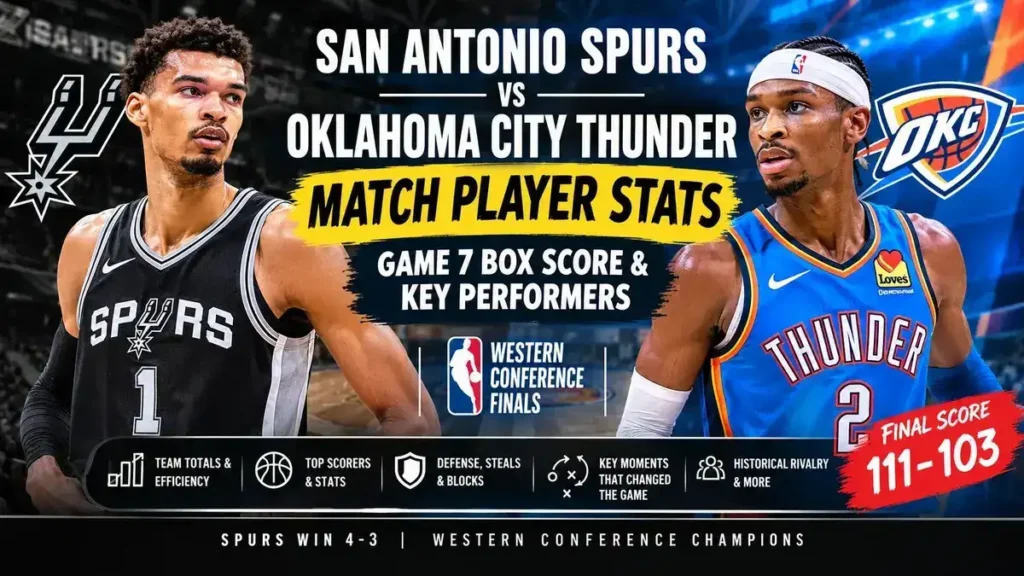
Finding clean game statistics can take more time than watching the game itself. Box scores often scatter scoring, shooting, rebounding, assists, turnovers, and defensive numbers across different pages. This guide brings the most important San Antonio Spurs vs Oklahoma City Thunder match player stats from the May 30, 2026 Western Conference Finals Game 7 into one easy reference, with the numbers explained in plain language.
The Spurs won 111–103 at Paycom Center and closed the Western Conference Finals 4–3. San Antonio led the game at halftime, survived multiple Oklahoma City runs, and pulled away again in the fourth quarter.
A Quick Look at the Rivalry
The Spurs and Thunder have built one of the more interesting Western Conference playoff rivalries of the modern NBA. Their postseason history includes meetings in 2012, 2014, 2016, and 2026, with the 2026 series becoming their latest seven-game battle.
The earlier playoff series produced very different stories. Oklahoma City defeated San Antonio 4–2 in the 2012 Western Conference Finals, while San Antonio answered with a 4–2 victory in the 2014 Western Conference Finals. Oklahoma City won another 4–2 series in the 2016 Western Conference semifinals.
The 2026 meeting therefore carried more than a normal regular-season rivalry. The Spurs entered as the No. 2 seed, while the Thunder entered as the No. 1 seed. Game 7 decided which team would advance to the NBA Finals.
For readers studying San Antonio Spurs vs Oklahoma City Thunder match player stats, the rivalry also shows why individual numbers need context. A 30-point performance can still end in defeat, while a balanced scoring attack can win a close elimination game.
The Most Recent Matchup: May 30, 2026
Game 7 took place at Paycom Center in Oklahoma City in front of a sellout crowd of 18,203. The Spurs won 111–103, taking the series 4–3 and claiming the Western Conference title.
San Antonio started strongly, scoring 32 points in the opening quarter while holding Oklahoma City to 25. The Thunder responded in the second quarter, cutting into the deficit and taking a 53–52 lead late in the half after a 20–5 scoring run.
The third quarter remained tight. Oklahoma City briefly moved ahead again, but San Antonio answered with a 16–4 run and carried an 80–77 advantage into the fourth.
The fourth quarter ultimately separated the teams. San Antonio scored 31 points compared with Oklahoma City’s 26 and finished the elimination game with an eight-point victory.
That sequence is central to the San Antonio Spurs vs Oklahoma City Thunder match player stats because the final score does not show how often the lead changed during the game.
Team Totals and Efficiency Comparison
The basic team numbers immediately show why this became such a competitive Game 7.
| Statistic | Spurs | Thunder |
|---|---|---|
| Final score | 111 | 103 |
| Field goals | 40-88 | 37-83 |
| FG% | 45.5% | 44.6% |
| 3-pointers | 17-40 | 12-35 |
| 3PT% | 42.5% | 34.3% |
| Free throws | 14-20 | 17-22 |
| Rebounds | 50 | 56 |
| Assists | 27 | 23 |
| Turnovers | 12 | 13 |
| Steals | 10 | 9 |
| Blocks | 4 | 5 |
San Antonio gained its biggest statistical advantage from three-point shooting. The Spurs made 17 threes at a 42.5% rate, compared with 12 made threes for Oklahoma City at 34.3%.
Oklahoma City controlled the glass, 56–50, and also scored 37 points from the bench compared with San Antonio’s 27. Those advantages were not enough to overcome the Spurs’ shooting efficiency and slightly better ball security.
This is one of the clearest lessons from the San Antonio Spurs vs Oklahoma City Thunder match player stats: the Thunder won several individual statistical categories, but San Antonio won the categories that had the biggest effect on the scoreboard.
Complete Point Guard and Playmaking Matchup
Basketball does not use quarterback statistics, so the relevant comparison centers on scoring creation, assists, turnovers, and shot efficiency.
San Antonio’s lead creators
Stephon Castle: 16 points, 6 assists, 6 rebounds, 1 steal, and 6 turnovers.
De’Aaron Fox: 15 points, 5 assists, 3 steals, and 2 turnovers.
Victor Wembanyama: 22 points, 7 rebounds, 2 assists, 1 steal, 1 block, and only 1 turnover.
Oklahoma City’s primary creator
Shai Gilgeous-Alexander: 35 points, 9 assists, 4 rebounds, 3 steals, 1 block, and 3 turnovers.
SGA produced the game’s highest individual scoring total. He shot 12-of-21 from the field, made 2-of-5 three-pointers, and converted 9-of-11 free throws.
Yet the San Antonio Spurs vs Oklahoma City Thunder match player stats show an important difference: San Antonio received significant production from several players rather than relying on one dominant scorer.
Castle and Fox combined for 31 points and 11 assists, while Wembanyama added 22 points. That distribution helped San Antonio withstand Gilgeous-Alexander’s 35-point performance.
Scoring Leaders and Offensive Production
Wembanyama led the Spurs with 22 points, but Julian Champagnie delivered one of the most important shooting performances of the night.
| Player | Team | PTS | FG | 3PT | REB | AST |
|---|---|---|---|---|---|---|
| Shai Gilgeous-Alexander | OKC | 35 | 12-21 | 2-5 | 4 | 9 |
| Victor Wembanyama | SAS | 22 | 7-15 | 3-5 | 7 | 2 |
| Julian Champagnie | SAS | 20 | 6-11 | 6-10 | 6 | 1 |
| Cason Wallace | OKC | 17 | 6-10 | 5-9 | 7 | 4 |
| Stephon Castle | SAS | 16 | 7-15 | 0-3 | 6 | 6 |
| De’Aaron Fox | SAS | 15 | 6-12 | 3-7 | 0 | 5 |
| Alex Caruso | OKC | 12 | 3-14 | 1-6 | 5 | 4 |
| Dylan Harper | SAS | 12 | 5-8 | 2-3 | 7 | 3 |
Champagnie deserves special attention. He scored 20 points while making six three-pointers on ten attempts and finished with a +16 plus-minus rating.
Cason Wallace also provided major perimeter scoring for Oklahoma City. He scored 17 points and made five of nine three-point attempts, but his production could not match the combined shooting output of San Antonio’s perimeter group.
The San Antonio Spurs vs Oklahoma City Thunder match player stats therefore point to a team-based scoring advantage for San Antonio rather than a single-player advantage.
Rebounding and Interior Battle
Oklahoma City won the rebounding battle 56–50. Jaylin Williams led the Thunder with 10 rebounds, while Cason Wallace and several other players contributed on the glass.
Wembanyama led San Antonio with seven rebounds. Dylan Harper also collected seven, while Champagnie, Vassell, and Castle each added six.
| Rebound Category | Spurs | Thunder |
|---|---|---|
| Total rebounds | 50 | 56 |
| Offensive rebounds | 10 | 10 |
| Defensive rebounds | 40 | 46 |
| Wembanyama | 7 | — |
| Jaylin Williams | — | 10 |
| Dylan Harper | 7 | — |
The Thunder’s six-rebound advantage shows that San Antonio did not win through dominance on the boards. Instead, the Spurs offset that weakness through perimeter efficiency, assists, and fewer turnovers.
Three-Point Shooting Made the Difference
Three-point shooting became one of the clearest separators.
San Antonio made 17 of 40 three-point attempts. Oklahoma City made 12 of 35. That gave the Spurs 51 points from three-point field goals compared with 36 for the Thunder.
Champagnie led the way with six made threes. Wembanyama and Fox each made three, while Dylan Harper added two.
Oklahoma City’s Wallace made five threes, but the Thunder did not receive enough additional perimeter production from the rest of the lineup.
For anyone studying the San Antonio Spurs vs Oklahoma City Thunder match player stats, this is perhaps the simplest statistical explanation for the result: San Antonio created a 15-point advantage from made three-pointers.
Defensive Plays, Turnovers, and Key Stops
San Antonio forced 13 Thunder turnovers while committing 12. The Spurs also recorded 10 steals, one more than Oklahoma City.
Wembanyama contributed one block and one steal. Vassell recorded two steals, Fox recorded three, and Castle added one.
Oklahoma City recorded five blocks. Chet Holmgren produced two blocks, while Cason Wallace added one and Alex Caruso added one.
The defensive numbers remained close, but San Antonio’s ability to turn defensive pressure into transition opportunities mattered. The Spurs finished with 19 fast-break points, compared with seven for Oklahoma City.
That transition advantage helped explain why the Spurs could survive Oklahoma City’s strong stretches.
Step-by-Step Game-Changing Moments
1. San Antonio’s fast start
The Spurs opened the game with a 32–25 first quarter. Wembanyama scored early, and San Antonio established offensive control before Oklahoma City settled into the game.
2. Oklahoma City’s second-quarter comeback
The Thunder erased the early deficit through a 20–5 scoring run. Oklahoma City tied the game at 49 and then moved ahead 53–52 late in the second quarter.
3. Spurs answer in the third
Oklahoma City took a 61–60 lead early in the third, but San Antonio responded with a 16–4 run. The Spurs entered the final period ahead 80–77.
4. San Antonio closes the game
The Spurs produced 31 fourth-quarter points while limiting Oklahoma City to 26. That final push ended the Thunder’s comeback attempts and secured the series.
These moments give the San Antonio Spurs vs Oklahoma City Thunder match player stats much more meaning than a simple list of box-score numbers.
What the Numbers Tell Us About Each Team
San Antonio Spurs
San Antonio’s biggest strength was balance. Wembanyama led the team in scoring, but Champagnie supplied 20 points, Castle scored 16, Fox scored 15, and Harper added 12.
The Spurs also moved the ball effectively, producing 27 assists. Their 17 made threes gave them a major scoring boost.
Oklahoma City Thunder
Oklahoma City received an outstanding performance from Gilgeous-Alexander. His 35 points and nine assists gave the Thunder a clear offensive centerpiece.
Wallace added 17 points and five made threes, while Jaylin Williams posted 11 points and 10 rebounds. But the Thunder needed more efficient perimeter shooting from the rest of the lineup.
The San Antonio Spurs vs Oklahoma City Thunder match player stats show a classic contrast: San Antonio won through balanced scoring and shooting efficiency, while Oklahoma City relied more heavily on its lead creator.
Historical Stars and How the Rivalry Has Unfolded
The rivalry has featured several generations of major NBA players. Earlier playoff meetings included Tim Duncan, Tony Parker, Manu Ginobili, Kevin Durant, Russell Westbrook, and James Harden.
The 2012 Western Conference Finals remain especially memorable because Oklahoma City recovered from a 2–0 deficit to win four consecutive games and reach the NBA Finals.
In 2014, San Antonio responded by defeating Oklahoma City 4–2 in the Western Conference Finals. The Spurs later won the championship that season.
The 2016 semifinal series again went Oklahoma City’s way, with the Thunder winning 4–2. The 2026 Game 7 therefore added another major chapter to a rivalry that has repeatedly produced high-stakes playoff basketball.
Why Player Stats Matter in This Matchup
Raw points tell only part of the story.
Gilgeous-Alexander’s 35 points were the highest individual total in Game 7, but San Antonio still won by eight. Wembanyama scored 22, Champagnie scored 20, Castle scored 16, and Fox scored 15, giving the Spurs four major contributors.
Efficiency also matters. Champagnie made six of ten three-point attempts, Wembanyama made three of five, and Fox made three of seven. Those shots helped compensate for Vassell’s 4-of-14 shooting night.
Turnovers tell another part of the story. San Antonio committed 12 compared with Oklahoma City’s 13, while also producing 10 steals and 19 fast-break points.
This makes the San Antonio Spurs vs Oklahoma City Thunder match player stats useful beyond fantasy-style player comparisons. The numbers explain how San Antonio won despite losing the rebounding battle.
Where to Verify the Box Score and Historical Data
For readers who want to cross-check individual numbers, the official NBA box score provides the primary game statistics and play-by-play data.
NBA.com official game box score
Basketball-Reference game box score
For broader basketball coverage and game analysis, ESPN also provides NBA scores, statistics, standings, and game information.
Note: NFL.com and Pro Football Reference are designed for American football, so they are not appropriate primary sources for this NBA matchup. Using them here would reduce topical relevance rather than improve it.
Final Thoughts and Fan Takeaways
The final score was San Antonio Spurs 111, Oklahoma City Thunder 103, but the deeper story sits inside the numbers.
Wembanyama delivered 22 points and seven rebounds. Champagnie supplied 20 points with six three-pointers. Castle added 16 points and six assists, while Fox contributed 15 points, five assists, and three steals.
Oklahoma City had the game’s top scorer in Gilgeous-Alexander, who finished with 35 points and nine assists. Wallace added 17 points and five threes, while Jaylin Williams recorded 10 rebounds.
But San Antonio won the more important team categories: 17 made threes to 12, 27 assists to 23, 12 turnovers to 13, and 19 fast-break points to seven.
The final San Antonio Spurs vs Oklahoma City Thunder match player stats tell a clear story: Oklahoma City produced the biggest individual scoring performance, while San Antonio produced the better overall team performance when the series was on the line.
FAQs
Who scored the most points in Spurs vs Thunder Game 7?
Shai Gilgeous-Alexander led all scorers with 35 points for Oklahoma City. Victor Wembanyama led San Antonio with 22 points.
Who led the Spurs in Game 7?
Victor Wembanyama led San Antonio with 22 points and seven rebounds. Julian Champagnie followed with 20 points and six made three-pointers.
Who won Spurs vs Thunder on May 30, 2026?
The San Antonio Spurs defeated the Oklahoma City Thunder 111–103 in Game 7 of the Western Conference Finals. San Antonio won the series 4–3.
What was the biggest statistical difference?
Three-point shooting created one of the largest gaps. San Antonio made 17 of 40 three-pointers, while Oklahoma City made 12 of 35.
Did Oklahoma City win any major statistical categories?
Yes. The Thunder won the rebounding battle 56–50 and scored 37 bench points compared with 27 for San Antonio. Those advantages were not enough to overcome the Spurs’ shooting and ball-security edge.