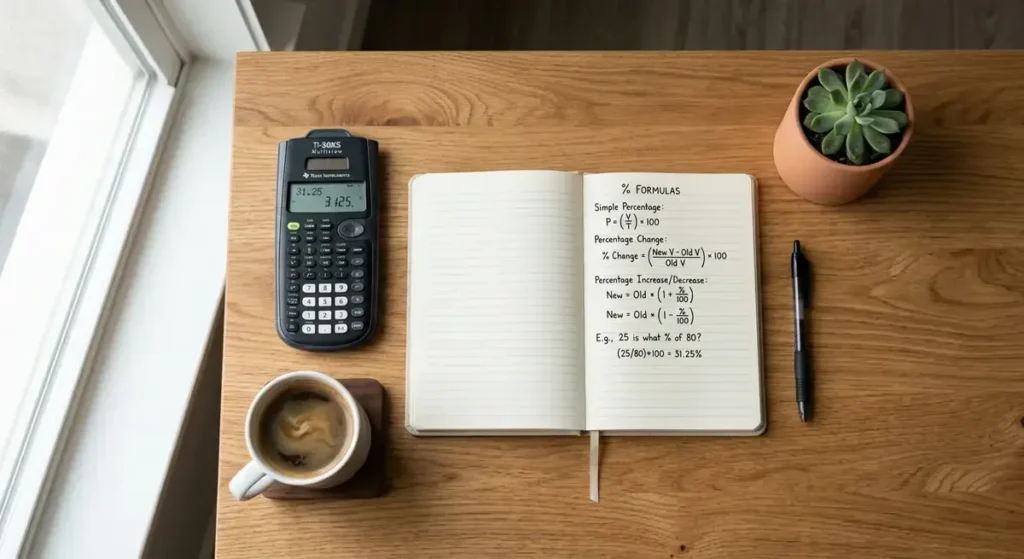
You stare at a restaurant bill, a report card, or a sale tag and your mind goes blank. Getting the math wrong drains your wallet and shakes your confidence. This percentage calculators hub hands you simple formulas, real-world examples, and quick answers so you handle every number with total ease.
What Is a Percentage Calculators Hub and Why You Need One
A percentage calculators hub collects every essential percent-based formula and method into a single, easy-to-navigate resource. Instead of jumping between random websites, you find everything from basic percent-of-a-number problems to advanced percent change equations right here.
Think of it as your personal math toolbox. You open it, grab the right formula, plug in your numbers, and walk away with the correct answer in seconds.
The National Council of Teachers of Mathematics (NCTM) confirms that students and adults who use structured reference tools retain math concepts far longer than those who rely on memorization alone (nctm.org).
How to Calculate a Percentage of a Number
This is the foundation of every other calculation in this percentage calculators hub. The formula is straightforward.
Formula: (Part ÷ Whole) × 100 = Percentage
Example: You scored 42 out of 50 on a quiz.
- 42 ÷ 50 = 0.84
- 0.84 × 100 = 84%
You earned an 84% on that quiz. No guesswork needed.
When you flip the question and need to find the part, rearrange the formula.
Formula: (Percentage ÷ 100) × Whole = Part
Example: What is 15% of 200?
- 15 ÷ 100 = 0.15
- 0.15 × 200 = 30
Fifteen percent of 200 equals 30.
Percentage Increase and Decrease Made Simple
Prices go up. Salaries shift. Populations grow. You need a reliable way to measure those movements.
Percentage Increase Formula: ((New Value − Old Value) ÷ Old Value) × 100
Example: Your rent jumped from $1,000 to $1,150.
- 1,150 − 1,000 = 150
- 150 ÷ 1,000 = 0.15
- 0.15 × 100 = 15%
Your rent increased by 15%.
Percentage Decrease Formula: ((Old Value − New Value) ÷ Old Value) × 100
Example: A jacket dropped from $80 to $60.
- 80 − 60 = 20
- 20 ÷ 80 = 0.25
- 0.25 × 100 = 25%
You saved 25% on that jacket.
Finding the Percent Change Between Two Values
Percent change and percent increase or decrease share the same DNA. The difference is that percent change tells you the direction — positive or negative — in one clean number.
Formula: ((Final Value − Initial Value) ÷ |Initial Value|) × 100
Example: A stock moved from $45 to $52.
- 52 − 45 = 7
- 7 ÷ 45 = 0.1556
- 0.1556 × 100 = 15.56%
The stock gained 15.56%. A negative result means the value dropped.
Khan Academy breaks down percent change with interactive exercises that reinforce this exact method (khanacademy.org).
Converting Fractions and Decimals to Percentages
You will run into fractions and decimals constantly. Converting them to percentages takes one step.
Fraction to Percent: Divide the numerator by the denominator, then multiply by 100.
- 3/4 → 3 ÷ 4 = 0.75 → 0.75 × 100 = 75%
Decimal to Percent: Multiply the decimal by 100.
- 0.62 × 100 = 62%
Percent to Decimal: Divide by 100.
- 89% ÷ 100 = 0.89
These quick conversions form the backbone of every problem in this percentage calculators hub.
Percentage Difference vs Percentage Change Explained
People mix these two up all the time. Here is the clear distinction.
- Percentage Change compares an old value to a new value over time. It shows growth or decline.
- Percentage Difference compares two values of equal standing. Neither value is “old” or “new.”
Percentage Difference Formula: (|Value 1 − Value 2| ÷ ((Value 1 + Value 2) ÷ 2)) × 100
Example: Store A sells a phone for $700. Store B sells it for $750.
- |700 − 750| = 50
- (700 + 750) ÷ 2 = 725
- 50 ÷ 725 = 0.069
- 0.069 × 100 = 6.9%
The price difference between the two stores is 6.9%.
Real-Life Situations Where You Use Percentages Daily
Percentages show up everywhere. You just do not always notice them.
- Shopping discounts: A 30% off sign on a $90 pair of shoes saves you $27.
- Tipping at restaurants: 20% of a $65 dinner bill equals a $13 tip.
- Tax calculations: An 8% sales tax on a $500 purchase adds $40.
- Loan interest rates: A 5% annual rate on a $10,000 loan costs $500 per year.
- Battery life: Your phone at 23% means roughly 23 out of every 100 units of charge remain.
- Grade averages: Scoring 88% across all assignments puts you in the B+ range at most schools.
The U.S. Bureau of Labor Statistics uses percentage change to report employment shifts, inflation rates, and wage growth every month (bls.gov).
A Complete Table of Common Percentage Formulas
| Calculation Type | Formula | Quick Example |
|---|---|---|
| Percent of a Number | (Part ÷ Whole) × 100 | 25 out of 200 = 12.5% |
| Find the Part | (Percent ÷ 100) × Whole | 10% of 300 = 30 |
| Find the Whole | Part ÷ (Percent ÷ 100) | 15 is 30% of 50 |
| Percent Increase | ((New − Old) ÷ Old) × 100 | $50 to $65 = 30% |
| Percent Decrease | ((Old − New) ÷ Old) × 100 | $80 to $60 = 25% |
| Percent Change | ((Final − Initial) ÷ Initial) × 100 | 40 to 50 = 25% |
| Percent Difference | ( | V1 − V2 |
| Fraction to Percent | (Numerator ÷ Denominator) × 100 | 3/8 = 37.5% |
| Decimal to Percent | Decimal × 100 | 0.45 = 45% |
| Percent to Decimal | Percent ÷ 100 | 72% = 0.72 |
Bookmark this table. It covers nearly every percent-based question you will face.
Tips to Avoid Common Percentage Calculation Mistakes
Even smart people trip over these errors. Watch out for them.
- Dividing by the wrong number. Always divide by the original or “whole” value, not the new one.
- Forgetting to multiply by 100. A result of 0.35 is not 0.35%. It is 35%.
- Mixing up increase and decrease. A 50% increase followed by a 50% decrease does not return you to the starting number. Try it: $100 → $150 → $75.
- Rounding too early. Keep full decimal values until the final step, then round.
- Ignoring the base. A 10% raise on $30,000 differs wildly from a 10% raise on $80,000.
Slow down, double-check your base number, and your answers will stay accurate.
How Students and Professionals Use This Percentage Calculators Hub
High school students use percent formulas to solve algebra problems and interpret data sets on standardized tests. College students apply them in statistics, finance, and chemistry courses.
Working professionals lean on percentages even harder.
- Marketers measure click-through rates and conversion rates.
- Accountants calculate profit margins and tax obligations.
- Project managers track completion rates and budget variances.
- Healthcare workers monitor patient improvement rates and medication dosages.
Every one of these roles benefits from keeping this percentage calculators hub within arm’s reach. The faster you pull the right formula, the faster you make sound decisions.
Building Your Own Quick-Reference Percentage Toolkit
You do not need fancy software to handle percentages. A simple system works best.
- Save the formula table above on your phone or print it for your desk.
- Practice with real numbers from your grocery receipts, utility bills, and pay stubs.
- Use your phone’s built-in calculator for on-the-spot math. The % button handles basic conversions instantly.
- Write down three percent problems each week and solve them by hand to keep your skills sharp.
- Return to this percentage calculators hub whenever you encounter an unfamiliar calculation type.
Consistency beats complexity. Five minutes of practice each week keeps your math instincts strong.
Take Control of Your Numbers Today
You now hold every formula, example, and shortcut you need to conquer percentage math. No more freezing at the checkout counter. No more guessing your tip. No more staring blankly at a spreadsheet column labeled “% Change.”
Open the formula table. Pick one calculation you avoided this week. Solve it right now using the steps above. Once you see how fast the answer appears, you will wonder why percentages ever felt difficult in the first place.
Share this percentage calculators hub with a friend who still calculates tips by rounding up to the nearest dollar. They will thank you later.