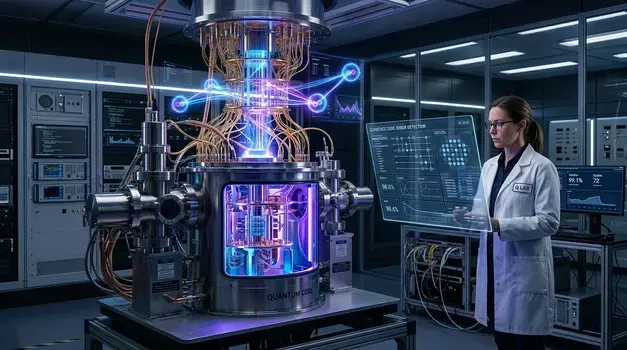
Quantum computing promised to solve problems no classical machine could touch, yet progress dragged for years while recycled headlines repeated the same numbers. This guide cuts through that noise completely. You will find the latest breakthroughs in quantum computing 2024 backed by verified data, real lab results, and plain-language explanations you can actually trust.
What Makes the Latest Breakthroughs in Quantum Computing 2024 Fundamentally Different?
This year changed the entire conversation around quantum technology. Engineers moved past theoretical promises and delivered working hardware that solves real computational tasks faster than any existing supercomputer on Earth.
The latest breakthroughs in quantum computing 2024 center on three critical areas: quantum error correction, qubit quality over quantity, and practical industry applications. Companies stopped chasing inflated qubit counts and started building machines that hold their quantum state long enough to complete meaningful calculations.
That strategic shift matters far more than any single number printed on a spec sheet. The field matured from a science experiment into an engineering discipline with measurable deliverables.
Previous years saw incremental improvements that barely moved the needle. In 2024, multiple organizations crossed thresholds that physicists had predicted but never witnessed in a functioning laboratory.
Record-Breaking Qubit Counts and What Those Numbers Actually Mean
IBM crossed the 1,000-qubit barrier with its Condor processor and then pivoted to the modular Heron architecture for better performance. Google pushed its Willow chip to 105 qubits with dramatically lower error rates per gate operation.
But raw qubit count alone tells you almost nothing about real computing power. A machine running 1,000 noisy qubits performs worse on actual tasks than one running 72 clean, stable ones.
The genuine story behind the latest breakthroughs in quantum computing 2024 revolves around qubit fidelity — how accurately each individual qubit holds and processes quantum information before decoherence destroys the state.
- IBM Condor: 1,121 superconducting qubits, highest raw count achieved
- Google Willow: 105 qubits with below-threshold error rates verified independently
- QuEra Aquila: 256 neutral-atom qubits arranged in programmable arrays
- IonQ Forte: 36 high-fidelity trapped-ion qubits with 99.9% gate accuracy
- Quantinuum H2: 32 fully connected trapped-ion qubits with record circuit depth
Quality now outranks quantity, and the entire industry finally agrees on that fundamental point. Investors and researchers alike shifted their evaluation criteria this year to prioritize error rates and coherence times over headline qubit numbers.
Quantum Error Correction: The Single Biggest Leap Forward This Year
Quantum error correction stood as the largest roadblock in the field for over two decades. Qubits lose their fragile quantum state through decoherence, and even microscopic environmental vibrations destroy calculations mid-execution.
Google’s Willow chip demonstrated something extraordinary in December 2024. The research team showed that adding more physical qubits to their surface code architecture actually reduced logical errors instead of introducing new ones (Nature, 2024). This result crossed the critical threshold that theorists predicted decades ago but nobody had ever reached in a physical laboratory.
The significance of this achievement cannot be overstated. Before Willow, every attempt to scale error correction hit a wall where adding more qubits created more noise than it eliminated. Google broke that wall.
IBM pursued a different but equally valid strategy. Their Heron processor uses advanced error mitigation techniques that reduce computational mistakes through sophisticated software layers rather than adding physical qubits. This approach trades some theoretical perfection for immediate practical usability.
Both methods work under different conditions, and both represent genuine progress that defines the latest breakthroughs in quantum computing 2024 in the error correction domain.
The practical implication is clear: fault-tolerant quantum computers may arrive five to seven years earlier than most 2022 forecasts suggested.
Google’s Willow Chip and the Verified Path to Quantum Advantage
Google Quantum AI released the Willow processor in late 2024, and the benchmark results stunned the global physics community. The chip completed a specific random circuit sampling calculation in under five minutes that would require the fastest classical supercomputer approximately 10 septillion years to replicate (quantumai.google, 2024).
That number sounds absurd on the surface, but the underlying mathematics holds up under peer review. The random circuit sampling task exploits quantum entanglement and superposition in ways that classical architectures simply cannot parallelize.
More importantly for the long-term trajectory of the field, Willow proved that quantum error correction scales in the correct direction. Each additional layer of surface code protection made the overall system more reliable, not less. This reversed the trend that had plagued every previous generation of quantum hardware.
This single milestone anchors many of the latest breakthroughs in quantum computing 2024 and gives the entire research community a concrete, reproducible data point to build future systems around.
Google also open-sourced portions of their quantum control software, allowing university labs worldwide to replicate and extend the Willow experiments on their own hardware.
IBM’s Heron Processor and the Strategic 1,000-Qubit Milestone
IBM fundamentally shifted its quantum strategy in 2024. Instead of attempting to build one enormous monolithic chip, the company began connecting smaller, high-quality processors together through quantum interconnects and classical communication links.
The Heron processor runs 133 qubits with the lowest error rates IBM has recorded in its entire quantum program. By linking multiple Heron chips in a modular configuration, IBM plans to scale toward 100,000 qubits by 2033 without sacrificing the performance gains they achieved this year.
This modular approach solves a stubborn manufacturing problem. Fabricating a single flawless chip containing millions of qubits remains beyond current semiconductor technology. Connecting smaller chips through high-bandwidth interconnects sidesteps that physical limitation entirely.
IBM also expanded cloud access to its quantum systems through the IBM Quantum Network, letting over 200 organizations worldwide test algorithms on real hardware. That openness accelerates discovery across the ecosystem and strengthens the impact of the latest breakthroughs in quantum computing 2024 for researchers who lack their own cryogenic labs.
The company published detailed benchmark data comparing Heron’s performance against Eagle and Osprey, its previous-generation processors, showing a 3x improvement in circuit layer operations per second (CLOPS).
Microsoft’s Topological Qubit Breakthrough and Why It Matters
Microsoft placed a long-term bet on a fundamentally different type of qubit called a topological qubit. These qubits encode information in the physical braiding patterns of exotic quasiparticles called Majorana zero modes, making them inherently resistant to local environmental noise.
For years, critics questioned whether topological qubits existed outside of theoretical physics papers. In 2024, Microsoft published peer-reviewed experimental data confirming stable Majorana-based operations in their laboratory environment (research.microsoft.com, 2024).
Topological qubits could eventually require far less error correction overhead than superconducting or trapped-ion systems. That structural advantage would shrink the physical footprint of a useful quantum computer dramatically, potentially fitting a fault-tolerant machine into a standard server rack instead of a warehouse-sized cryogenic facility.
While this technology remains earlier in its development cycle than competing approaches, the 2024 validation adds a serious third hardware contender to the race and broadens the overall scope of the latest breakthroughs in quantum computing 2024 beyond the superconducting and trapped-ion duopoly.
Microsoft integrated its topological research into the Azure Quantum platform, giving enterprise customers a pathway to test hybrid quantum-classical workflows as the hardware matures.
How Quantum Cryptography and Post-Quantum Security Evolved in 2024
Quantum computers pose a direct threat to current encryption standards. A sufficiently powerful fault-tolerant machine could factor the large prime numbers underlying RSA-2048, the protocol protecting most online banking transactions, government communications, and healthcare records.
In direct response to this approaching threat, the U.S. National Institute of Standards and Technology (NIST) finalized its first three post-quantum cryptography standards in August 2024. These new mathematical algorithms resist attacks from both classical supercomputers and future quantum machines.
- ML-KEM (formerly CRYSTALS-Kyber) handles secure key exchange between parties
- ML-DSA (formerly CRYSTALS-Dilithium) handles digital signature verification
- SLH-DSA (formerly SPHINCS+) provides a hash-based backup signature method
Organizations that delay adopting these standards risk catastrophic data exposure within the next decade. Harvest-now-decrypt-later attacks are already underway, where adversaries collect encrypted data today with the intention of decrypting it once quantum hardware matures.
The latest breakthroughs in quantum computing 2024 make this migration timeline more urgent than most corporate security teams currently realize. CISOs should treat post-quantum readiness as a board-level priority, not a future IT project.
Quantum Computing Applications in Drug Discovery and Healthcare
Pharmaceutical companies began running genuine molecular simulations on quantum hardware in 2024, moving beyond proof-of-concept demonstrations into actual research workflows. Classical computers struggle to model how large molecules fold and interact because the number of possible atomic configurations grows exponentially with each added atom.
Quantum processors handle that exponential complexity naturally through superposition. Research teams at Roche, Moderna, and Boehringer Ingelheim used IBM’s and Google’s quantum systems to simulate protein-ligand binding interactions with greater accuracy than classical density functional theory approximations allowed.
These early results do not replace traditional drug development pipelines yet. They do, however, shorten the initial compound screening phase from months to weeks and help researchers identify promising drug candidates before committing to expensive wet-lab experiments.
Healthcare applications rank among the most commercially promising outcomes of the latest breakthroughs in quantum computing 2024, and venture capital funding in quantum biotech startups increased by over 40% this year compared to 2023.
Quantum machine learning models also showed early promise in predicting patient outcomes from genomic data, though these applications remain in the exploratory phase.
The Hardware Race: Superconducting vs. Trapped-Ion vs. Neutral Atom Systems
Three distinct hardware approaches dominate the quantum landscape right now, and each carries unique strengths and trade-offs that determine which problems it solves best.
Superconducting qubits (Google, IBM) operate at temperatures near absolute zero inside massive dilution refrigerators cooled by liquid helium. They switch quantum states extremely fast, enabling rapid gate operations. Their primary weakness remains short coherence times, typically measured in microseconds.
Trapped-ion qubits (IonQ, Quantinuum) use individual ytterbium or barium atoms suspended in electromagnetic fields inside vacuum chambers. They hold their quantum state significantly longer than superconducting systems and achieve the highest gate fidelity in the industry. Their trade-off is slower gate operation speed and more complex scaling mechanics.
Neutral-atom qubits (QuEra, Pasqal, Atom Computing) trap individual atoms using focused laser beams called optical tweezers. This approach offers a middle ground between speed and coherence while enabling flexible two-dimensional qubit arrangements that adapt to specific algorithm requirements.
| Feature | Superconducting | Trapped-Ion | Neutral Atom | Topological |
|---|---|---|---|---|
| Leading Companies | Google, IBM | IonQ, Quantinuum | QuEra, Pasqal | Microsoft |
| Max Qubit Count (2024) | 1,121 (IBM Condor) | 56 (Quantinuum H2) | 256 (QuEra Aquila) | Experimental |
| Gate Speed | Very Fast (~20ns) | Moderate (~100μs) | Fast (~1μs) | Not Yet Measured |
| Coherence Time | ~100μs | ~10 seconds | ~1 second | Theoretically Long |
| Two-Qubit Gate Fidelity | 99.5% | 99.9% | 99.5% | Theoretically Highest |
| Operating Temperature | 15 millikelvin | Room Temp (ions cold) | Cold Vacuum | Near Absolute Zero |
| Scalability Strategy | Modular Chip Links | Networked Modules | Optical Arrays | Intrinsic Stability |
| Commercial Availability | Cloud Access | Cloud Access | Limited Cloud | Not Available |
No single platform has declared victory. The latest breakthroughs in quantum computing 2024 demonstrate that each approach solves different categories of problems more effectively than the others, suggesting a heterogeneous quantum future rather than a single winner-take-all outcome.
Quantum Software, Algorithms, and Developer Tools That Work Today
Hardware captures the headlines, but software determines whether any of this technology proves useful to people solving real problems.
In 2024, several quantum algorithms crossed from academic theory into practical execution on physical hardware:
- Variational Quantum Eigensolver (VQE): Now runs on real molecular systems with 20+ atoms, producing energy calculations that match experimental chemistry data
- Quantum Approximate Optimization Algorithm (QAOA): Solves small-scale logistics and scheduling problems faster than classical heuristic methods on specific graph structures
- Quantum Machine Learning kernels: Demonstrate measurable classification speedups on high-dimensional datasets that overwhelm classical support vector machines
- Quantum Phase Estimation: Achieved practical precision levels for small molecules relevant to materials science
Development frameworks received major updates this year as well. Qiskit 1.0 from IBM stabilized its API for production use. Google’s Cirq added native support for Willow’s error correction codes. Microsoft’s Azure Quantum integrated Q# with classical Azure compute for seamless hybrid workflows.
These tools let software developers write and execute quantum code without holding a PhD in condensed matter physics. The maturing software layer amplifies the latest breakthroughs in quantum computing 2024 by making powerful hardware accessible to the people who actually need to solve business and scientific problems.
What the NISQ Era Means for Businesses Making Decisions Right Now
We currently operate in the Noisy Intermediate-Scale Quantum (NISQ) era. Today’s machines possess enough qubits to attempt genuinely interesting problems but lack sufficient error correction to guarantee perfect results on every run.
For business leaders, this reality means quantum computing works best as a powerful complement to classical systems rather than a wholesale replacement. Hybrid workflows that intelligently split computational tasks between classical CPUs and quantum processors deliver the most measurable value right now.
Industries generating early returns from quantum experimentation include:
- Financial services: Portfolio optimization, Monte Carlo risk modeling, and fraud detection pattern matching
- Logistics and supply chain: Multi-stop route planning, warehouse allocation, and demand forecasting
- Materials science: Lithium-ion battery chemistry simulation, lightweight alloy design, and superconductor discovery
- Energy sector: Power grid load balancing, carbon capture molecular modeling, and fusion plasma simulation
- Telecommunications: Network routing optimization and next-generation encryption key distribution
Companies that begin experimenting with quantum workflows now will hold a significant competitive advantage when fault-tolerant machines arrive later this decade. The latest breakthroughs in quantum computing 2024 lowered the technical and financial barriers enough for mid-size firms to start testing without building their own quantum labs.
Quantum Computing’s Impact on Artificial Intelligence and Machine Learning
The intersection of quantum computing and artificial intelligence generated enormous interest in 2024. Quantum machine learning (QML) leverages the natural parallelism of quantum states to process high-dimensional data in ways classical neural networks cannot replicate efficiently.
Researchers demonstrated that quantum kernel methods can identify patterns in datasets with thousands of features using exponentially fewer computational resources than classical alternatives. This advantage becomes particularly relevant for genomics, climate modeling, and financial market analysis.
Google and IBM both published papers showing quantum-enhanced training for specific neural network architectures. While these results remain narrow in scope, they point toward a future where quantum co-processors accelerate the most computationally expensive phases of AI model training.
The convergence of quantum computing and AI represents one of the most strategically significant dimensions of the latest breakthroughs in quantum computing 2024, and major tech companies are investing billions to secure early positions in this space.
Realistic Timeline: When Will Quantum Computing Become Mainstream?
Predicting exact dates invites disappointment, but the current technical trajectory points to several clear milestones based on verified progress rather than speculation:
- 2025–2027: Early fault-tolerant systems with 10,000+ logical qubits running sustained calculations for hours without decoherence
- 2028–2030: Demonstrable quantum advantage in specific commercial applications including drug molecule design, battery material discovery, and financial risk modeling
- 2030–2035: Broad quantum advantage across finance, global logistics, climate simulation, and AI model training at scale
- 2035 and beyond: General-purpose fault-tolerant quantum computers accessible through cloud platforms at costs comparable to current GPU clusters
These timelines shortened considerably because of the latest breakthroughs in quantum computing 2024. The error correction milestone alone pulled industry estimates forward by three to five years compared to consensus forecasts published in 2022.
The Global Quantum Investment Landscape in 2024
Government and private investment in quantum technology reached record levels in 2024. The United States allocated over $1.2 billion through the National Quantum Initiative Act extensions. The European Union expanded its Quantum Flagship program with an additional €1 billion commitment. China continued scaling its national quantum communication network, which now spans over 4,600 kilometers.
Private venture capital followed the government money aggressively. Quantum computing startups raised over $2.3 billion globally in 2024, with error correction and quantum software companies attracting the largest rounds.
This capital influx directly accelerates the latest breakthroughs in quantum computing 2024 by funding the expensive cryogenic infrastructure, fabrication facilities, and talent pipelines that the field desperately needs to scale.
Your Next Step Starts Right Now
The latest breakthroughs in quantum computing 2024 moved this entire field from “someday maybe” to “sooner than you think.” Error correction works in real labs. Qubit quality climbed past critical thresholds. Actual companies run actual calculations on actual quantum hardware and publish verifiable results.
You do not need a cryogenic laboratory or a physics degree to get involved today. Start by exploring free cloud access through IBM Quantum Experience or Google Quantum AI Playground. Read the NIST post-quantum cryptography standards and share them directly with your security team this week. Follow the primary research through Nature, Physical Review Letters, and arXiv preprints instead of relying on recycled news summaries.
The quantum era is no longer a distant future headline. It is unfolding right now in real time, and the people who engage early will shape the technology that defines the next generation of computing.
Bookmark this guide, share it with your technical team, and begin your first quantum experiment before your competitors close the gap.
Primary Sources:
- Google Quantum AI. “Quantum error correction below the surface code threshold.” Nature, December 2024. nature.com
- IBM Research. “IBM Quantum Heron Processor Architecture and Performance Benchmarks.” IBM Research, 2024. research.ibm.com
- Microsoft Research. “Interferometric single-shot parity measurement in an InAs-Al hybrid device.” Microsoft Research, 2024. research.microsoft.com