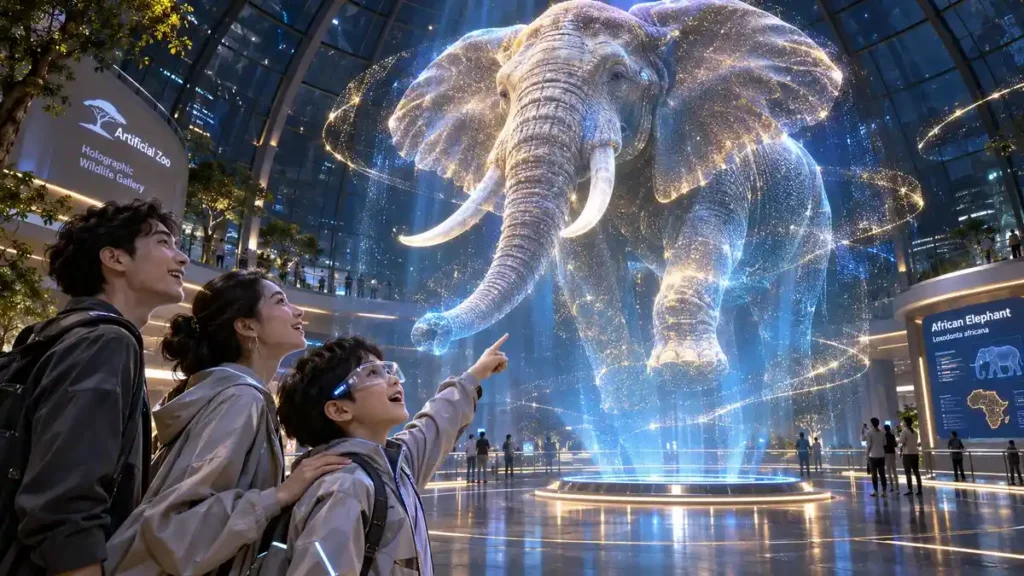
TL;DR: An artificial zoo uses holograms, biomimetic robotics, virtual reality, and sensory projection to let visitors experience wildlife without keeping live animals in captivity. These facilities eliminate animal welfare concerns, lower ongoing care costs, and let guests walk alongside extinct or endangered creatures in urban spaces.
Have you ever locked eyes with a silverback gorilla behind thick glass and felt a quiet tug of guilt? Most of us love seeing magnificent animals up close, yet we feel increasingly uneasy about keeping wild creatures in enclosed spaces. That exact tension has sparked one of the most fascinating shifts in modern entertainment and education: the rise of the artificial zoo.
Instead of iron bars and concrete enclosures, these high-tech attractions use laser holography, life-sized animatronics, and multi-sensory virtual environments to bring the wild to you. In this guide, you’ll learn how these simulated sanctuaries work, where you can visit them right now, and how they compare to traditional wildlife parks. Whether you’re a curious traveler, an educator, or an entertainment professional, you’ll see why synthetic wildlife parks are changing how we connect with nature.
Quick Overview: Key Facts at a Glance
- Zero Live Captivity: Visitors interact with life-sized holograms, hyper-realistic robots, and projection-mapped ecosystems instead of caged animals.
- Multi-Sensory Immersion: Modern venues combine 3D visuals with spatial audio, wind jets, temperature shifts, and custom scent diffusers.
- Impossible Encounters: Guests can swim beside a 90-foot blue whale, watch a prehistoric wooly mammoth graze, or shrink down to the size of an insect.
- Lower Operational Footprint: Without veterinary bills, specialized food supply chains, or massive land requirements, these attractions fit right inside shopping malls and city centers.
- Educational Focus: Schools and museums use these digital models to teach anatomy, animal behavior, and habitat preservation interactively.
What Exactly Is an Artificial Zoo and Why Does It Exist?
Definition: An artificial zoo is a wildlife attraction that replaces live captive animals with technological simulations—such as volumetric holograms, biomimetic robotics, augmented reality (AR), and virtual reality (VR)—to replicate the sights, sounds, and behaviors of wild species in their natural habitats.
For over two centuries, watching exotic animals meant bringing them from jungles, savannas, and oceans into city centers. While modern zoological parks do vital conservation work, certain species simply don’t thrive in human-made enclosures. Great white sharks, elephants, cetaceans, and polar bears need vast territories and complex social structures that even the wealthiest facilities struggle to replicate.
Public attitudes have shifted dramatically over the past twenty years. Documentaries, animal welfare campaigns, and scientific discoveries about animal sentience have made ticket buyers ask tougher questions about captivity. How do we inspire children to care about wildlife without compromising the freedom of the animals themselves?
The Ethical Push Behind Synthetic Wildlife
The demand for cruelty-free entertainment isn’t just a passing trend. Several countries, including Canada, France, and the United Kingdom, have passed strict laws phasing out captive cetacean shows or banning wild animals in traveling circuses. Entertainment developers realized that if they wanted to keep audiences engaged with nature, they needed a medium that didn’t rely on physical confinement.
By removing live specimens from the equation, simulated wildlife parks eliminate enclosure stress, zoochosis (repetitive stereotypic behaviors), and the risks of transporting wild fauna across borders. Visitors get the thrill of standing inches away from an apex predator without a single animal losing its freedom. Plus, nobody has to worry about a toddler falling into a dangerous enclosure or an escaped animal getting harmed.
Bridging the Gap Between Entertainment and Empathy
Skeptics often wonder if pixels and silicone can genuinely move the human heart. Surprisingly, early visitor studies from immersive nature exhibits show that people react with gasps, laughter, and protective instincts when a simulated baby elephant walks past them. When technology tricks your visual and auditory cortex into believing a creature occupies the same room as you, your brain triggers a very real emotional response.
How Do These High-Tech Wildlife Parks Actually Work?
Walking through a simulated wildlife park isn’t like watching a flat movie screen at your local cinema. Instead of passive viewing, these spaces rely on a synchronized “sensory stack” that tracks where you’re looking and adjusts the environment around you in real time. How do engineers make a ghost made of light or a machine made of silicone feel alive?
It takes five core systems working together behind the scenes:
- Volumetric 3D Capture and LiDAR Scanning: Filmmakers and computer scientists use arrays of depth-sensing cameras to record real animals in the wild or create anatomically accurate digital twins down to individual strands of fur.
- Laser Light Fields and Position Tracking: Visitors wear lightweight polarized glasses studded with reflective tracking markers. Ceiling sensors detect your exact head position and project two slightly different laser images to your left and right eyes, creating a solid-looking 3D hologram that floats in mid-air.
- Biomimetic Robotics and Soft Actuators: In aquatic and tactile exhibits, engineers build skeletal frames out of carbon fiber and wrap them in medical-grade silicone skin. Pneumatic and electric motors mimic the exact fluid dynamics of a swimming dolphin or the breathing chest of a resting big cat.
- 4D Environmental Conditioning: Sight and sound only do half the job. Hidden vents release the earthy smell of damp rainforest soil, mist sprayers cool your face when a holographic hippo splashes in a river, and subwoofers under the floor vibrate when a rhino charges past.
- AI-Driven Behavioral Engines: Rather than playing the exact same pre-recorded loop every three minutes, modern installations use game engines (like Unreal Engine) paired with artificial intelligence. If you wave your hand or step closer to a virtual giraffe, the digital animal notices you, tilts its head, and decides whether to approach or wander away.
Traditional zoos have also started borrowing from this playbook to supplement their live habitats. According to the Association of Zoos and Aquariums, accredited institutions invest heavily in public education and conservation science, and many now integrate digital storytelling to explain ecosystems that can’t be housed indoors. By blending interactive tech with conservation messaging, facilities can show visitors how animals behave in the wild without disturbing fragile species.
What Technologies Power Modern Simulated Exhibits?
Not every tech-driven wildlife center looks the same. Some focus entirely on free-roaming laser projections, while others build water tanks filled with lifelike mechanical swimmers. The technology a venue chooses depends on its budget, floor space, and whether guests want a hands-on experience or a visual spectacle.
Below is a breakdown of the primary technologies—and key industry concepts—shaping this space right now:
| Technology / Concept | How It Is Used in the Park | Sensory Realism | Cost to Deploy | Best Use Case |
|---|---|---|---|---|
| Holographic Wildlife | Laser light-field projectors beam 3D animals into tunnels, rooms, and open enclosures for glasses-wearing guests. | High visual depth; zero physical touch. | Medium to High | Large herds, extinct dinosaurs, or giant marine life like blue whales. |
| Robotic Animals | Free-swimming or walking animatronics built with medical silicone, internal batteries, and AI navigation sensors. | Extremely high; guests can actually touch and swim with them. | Very High | Marine parks replacing captive dolphins, sharks, and sea turtles. |
| Virtual Reality Safari | Wireless VR headsets combined with motion platforms or free-roaming warehouse floors. | Total visual and audio immersion; can cause motion sickness for some. | Low to Medium | Small urban footprints, schools, and traveling museum pop-ups. |
| Animatronic Exhibits | Stationary or track-bound mechanical creatures with realistic skin, fur, and synchronized vocalizations. | High tactile and visual presence; limited movement range. | Medium | Educational anatomy displays, prehistoric parks, and themed dark rides. |
| Projection Mapping | High-lumen projectors coat floors, walls, and artificial trees with reactive digital flora and fauna. | Moderate; great for group ambiance and toddler-friendly play. | Medium | Interactive ecosystems, nocturnal insect forests, and coral reef rooms. |
| Digital Conservation | Cloud-based 3D bio-archives that preserve the exact movement, bone structure, and vocalizations of endangered species. | Variable (depends on the display medium used). | Low (once captured) | Scientific research, global classroom streaming, and genetic heritage records. |
Why Hybrid Venues Win Over Audiences
If you spend an hour strictly inside a VR headset, your eyes get tired, and you feel isolated from the friends or family members you came with. That’s why the smartest attraction designers mix and match the tools in the table above. You might start your visit walking through a projection-mapped rainforest with your kids, put on lightweight 3D glasses for a holographic safari tunnel, and finish by petting a lifelike robotic sea lion in a shallow pool.
This hybrid approach solves the biggest complaint people have about screen-based entertainment: social isolation. When you can point at a floating three-dimensional elephant and see your child duck out of the way of its swinging trunk at the exact same moment, the experience feels shared and real.
Where Can You Visit Real-World Digital and Robotic Wildlife Parks Today?
You might think these facilities only exist in science fiction movies or architectural concept art. In reality, millions of ticket buyers have already walked through synthetic wildlife attractions across Australia, North America, Asia, and Europe. Let’s look at three groundbreaking examples operating right now.
1. Brisbane’s Hologram Zoo (Axiom Holographics)
Opened in 2023 in Queensland, Australia, the Hologram Zoo built by Axiom Holographics is widely recognized as the world’s first comprehensive holographic wildlife park. Spanning over 16,000 square feet, the venue uses laser projection tunnels and hollow rooms where life-sized animals appear to walk right out of the walls. CEO Bruce Dell designed a depth-tracking system that lets entire families walk around a three-dimensional polar bear or look up as a 90-foot whale swims directly overhead.
What makes the Brisbane facility stand out is its rotating geographic themes and 4D effects. One month you can traverse an African savanna complete with simulated heat and dust smells; the next month, you can walk through an Arctic blizzard or a prehistoric dinosaur swamp. Because the “animals” are software files, updating an entire wing of the facility takes a software upload rather than a multi-million-dollar construction project.
2. Edge Innovations and Biomimetic Marine Parks
For decades, marine parks faced intense criticism over keeping bottlenose dolphins and orcas in concrete tanks. Enter Edge Innovations, a California-based engineering firm famous for building the animatronic creatures in Hollywood hits like Free Willy, Flipper, and Deep Blue Sea. Working alongside former Walt Disney Imagineers, the company engineered a 600-pound, 8.5-foot animatronic dolphin made with medical-grade silicone skin and realistic skeletal weight distribution.
When placed in a pool, this robotic swimmer is virtually indistinguishable from a living dolphin. It nods, clicks, leaps, and lets swimmers hold onto its dorsal fin without ever getting stressed, biting a guest, or needing antibiotics. While initially pitched to theme parks in China to replace live marine mammal imports, the technology is now used for educational marine camps, therapeutic swimming programs, and luxury resort aquariums.
3. Immersive Eco-Museums and Projection Sanctuaries
Across major cities like New York, Las Vegas, and Tokyo, experiential hubs like Arcadia Earth and teamLab Planets have turned projection mapping and augmented reality into interactive wildlife sanctuaries. At Arcadia Earth, visitors walk through rooms built from upcycled materials while wearing AR headsets or using phones to watch endangered sea turtles and pollinators populate the space around them. Each room pairs dazzling digital creatures with hard truths about plastic pollution, overfishing, and deforestation, showing guests small daily habits they can change before they exit into the gift shop.
How Does a Traditional Park Compare to an Artificial Zoo?
Should synthetic parks completely replace traditional zoological gardens? Most biologists and educators say no—instead, they view the two models as serving very different purposes. Traditional accredited parks act as genetic arks for breeding programs and veterinary research, whereas an artificial zoo acts as a high-impact theatre for mass education and ethical entertainment.
Here is how the two models stack up side by side:
| Feature / Metric | Traditional Zoological Park | Artificial Zoo |
|---|---|---|
| Animal Welfare Risk | Moderate to High (depends on accreditation, enclosure size, and species). | Zero (no living creatures are kept in captivity). |
| Land Requirements | 50 to 2,000+ acres of outdoor real estate. | 10,000 to 50,000 sq. ft. indoors (fits in malls or downtown buildings). |
| Species Variety | Limited by climate, diet availability, and ethical captivity laws. | Unlimited (includes deep-sea fauna, microscopic life, and extinct species). |
| Weather Dependency | High (rain, snow, or extreme heat keeps both animals and guests indoors). | None (100% climate-controlled year-round operation). |
| Upfront vs. Ongoing Costs | High land/construction cost + massive ongoing food and veterinary bills. | High initial hardware/software cost + low ongoing electricity and maintenance bills. |
| Direct Genetic Conservation | High (participates in Species Survival Plans and reintroduction programs). | None directly (cannot breed animals, though ticket sales can fund field work). |
While synthetic venues can’t breed endangered frogs or nurse injured eagles back to health, they play a huge role in preserving knowledge about vanishing biodiversity. According to the International Union for Conservation of Nature Red List, more than 44,000 species are currently threatened with extinction worldwide. Digital bio-archives allow scientists and animators to scan and preserve the exact anatomy, vocal patterns, and locomotion of critically endangered creatures so future generations can still study them in three dimensions.
Can Virtual and Robotic Animals Actually Help Real Wildlife Conservation?
It’s easy to dismiss a room full of lasers and robots as a high-tech arcade. Yet conservationists are increasingly teaming up with digital attraction builders to protect real ecosystems. How does a simulated animal in a city mall help a real tiger in Sumatra?
Eliminating the Wild Capture of Marine Mammals and Exotic Species
In several parts of the world, rapid theme park expansion has fueled a lucrative black market for wild-caught beluga whales, dolphins, whale sharks, and primates. Capturing these intelligent animals tears apart wild social pods and results in high mortality rates during transit. When developers install biomimetic robotic animals and holographic aquariums instead, they cut off the financial demand for wild capture at the knees.
Furthermore, a mechanical shark or holographic manta ray never dies in captivity after a few weeks of refusal to eat. For species that have never survived in human care—like the great white shark or the giant squid—simulation is the only way the public can ever see them at full scale.
Creating Digital Twins and Bio-Archives
Field researchers now use non-invasive photogrammetry and drone LiDAR to map wild animals in their native habitats. That data feeds directly into digital conservation libraries. When an educational center licenses those 3D models for an exhibit, licensing royalties flow right back to the field researchers and indigenous rangers protecting the real animals on the ground.
Funding Field Recovery Through High-Margin Urban Attractions
Traditional zoos spend up to 70% of their annual revenue just keeping the lights on, buying tons of fresh produce and meat, and paying specialized veterinary teams. Because a tech-driven wildlife center has much lower daily operating overhead, it can dedicate a higher percentage of ticket proceeds to habitat protection trusts. Some venues even let guests scan a QR code next to a virtual orangutan to sponsor a real acre of Borneo rainforest on the spot.
What Are the Biggest Limitations and Criticisms of Synthetic Menageries?
For all their futuristic charm, simulated wildlife parks aren’t perfect. If you’re planning to visit one—or considering investing in the industry—you should know where the technology still falls short.
The Loss of Biological Presence and Unscripted Chaos
Part of the magic of watching real nature is its unpredictability. When you watch a real meerkat colony, every twitch, squabble, and dig is completely unscripted, driven by millions of years of evolutionary instinct. Even with advanced AI behavior trees, sharp-eyed visitors eventually notice repeating animation patterns or mechanical hums in animatronic exhibits.
There’s also a philosophical concern raised by environmental psychologists. Does replacing real nature with clean, sanitized, air-conditioned digital versions make humans even more disconnected from the messy, smelly, fragile biosphere we actually live in? If children grow up thinking a forest is something you turn on with a light switch, we have to make sure they don’t lose respect for the real woods outside.
High Energy Consumption and Hardware Obsolescence
Keeping dozens of high-lumen laser projectors, GPU server racks, and 4D environmental systems running twelve hours a day consumes a significant amount of electricity. Unless a venue runs on renewable energy, its carbon footprint can be surprisingly steep. Additionally, computer graphics age fast; a holographic rendering that looks breathtaking today might look like an outdated video game in five years, requiring regular software and hardware upgrades.
What Does It Cost to Build and Run a Tech-Driven Wildlife Attraction?
For entrepreneurs, museum directors, and commercial real estate owners, the economics of synthetic wildlife venues are uniquely attractive. With large department stores leaving shopping malls empty, landlords are scrambling for “experiential retail” tenants that bring families through the doors on weekends.
Building a mid-sized holographic or mixed-reality wildlife park (roughly 15,000 to 20,000 square feet) typically costs between $1.5 million and $5 million in upfront capital expenditure. That budget covers laser projection hardware, spatial tracking arrays, soundproofing, interior theming, and software licensing. By comparison, building a single new elephant or polar bear habitat at a traditional zoo frequently exceeds $20 million to $40 million.
If you choose to incorporate custom free-swimming robotic animals, expect hardware costs to climb. A single medical-grade animatronic dolphin costs roughly $3 million to $5 million to engineer and manufacture. Oddly enough, that is still competitive with the market price and specialized life-support tank costs of maintaining a live cetacean, without any of the legal liabilities, PR crises, or round-the-clock veterinary bills.
Once the doors open, ongoing operational costs stay remarkably lean. A facility only needs a small retail and guest-services staff, an IT technician to calibrate projectors, and routine cleaning crews. When ticket sales slow down after six months, the operator simply downloads a new seasonal adventure—like a deep-sea trench expedition or an Ice Age safari—to bring repeat customers back without moving a single brick.
How Will AI and Biometrics Shape the Next Decade of Wildlife Exhibits?
We are only in the opening chapter of synthetic nature experiences. Over the next ten years, three converging technologies will erase almost every barrier between the digital animal and the human observer.
First, generative AI simulation engines will replace pre-animated loops entirely. Digital creatures will possess virtual hunger drives, curiosity levels, and memories of past visitor interactions. If a crowd is loud and chaotic, a virtual snow leopard might retreat to a high rocky ledge and watch cautiously; if a single visitor stands quietly, it might pad down to the glass and purr.
Second, ultrasonic mid-air haptics will let you feel holograms without wearing bulky gloves. Using focused arrays of ultrasound waves, exhibitors can create localized air pressure on your bare palms. When you reach out to touch a holographic butterfly or the rough hide of a virtual rhino, you’ll feel a distinct tingling resistance right in empty air.
Finally, expect to see live satellite telepresence. Instead of purely computer-generated graphics, 360-degree high-definition cameras hidden at real watering holes in Kenya or coral reefs in Australia will beam live volumetric feeds directly into urban projection domes. You’ll stand in downtown Chicago or London while watching a real herd of elephants drink under the African sun in real time, blending the authenticity of the wild with the zero-impact footprint of a virtual reality safari.
Key Takeaways
- Ethical Evolution: Simulated wildlife parks let visitors experience exotic and endangered animals up close with zero animal captivity or welfare compromises.
- Multi-Tech Ecosystem: The best venues combine volumetric laser holograms, biomimetic robotics, projection mapping, and 4D scents to engage all your senses.
- Real-World Traction: Attractions like Brisbane’s Hologram Zoo and Edge Innovations’ robotic dolphins prove that ticket buyers eagerly embrace synthetic wildlife.
- Complementary Role: Tech-driven parks don’t replace the genetic breeding work of accredited zoos, but they excel at urban education and eliminating the wild capture of marine mammals.
- Smart Economics: Lower space requirements, zero veterinary bills, and downloadable exhibit updates make these venues ideal for malls, museums, and city centers.
Frequently Asked Questions (FAQ)
How much does it cost to visit an artificial zoo?
Ticket prices generally range from $20 to $45 per person, making them comparable to a standard movie theatre IMAX ticket or a local aquarium visit. Many venues offer family bundle discounts, school field trip rates, and shorter 30-minute express experiences for budget-conscious visitors.
Do you have to wear a heavy VR headset at holographic wildlife parks?
No, most modern holographic parks do not use bulky VR headsets. Instead, you wear lightweight polarized glasses—similar to standard 3D movie glasses—equipped with tiny reflective sensors that track your walking position so the laser projections look solid from your exact angle.
Can young children and people with motion sickness enjoy these exhibits?
Yes, walk-through holographic and animatronic parks are much gentler on the inner ear than traditional virtual reality headsets. Because you can still see the real floor beneath your feet and your family members beside you, motion sickness is rare, though children under four may find some 4D sound effects startling.
Are robotic dolphins and sharks safe to swim with?
Biomimetic swimming robots are engineered specifically for human interaction with soft medical-grade silicone exteriors, rounded edges, and enclosed propulsion systems. Unlike wild marine mammals, they never bite out of aggression or carry zoonotic diseases, and human operators can pause them instantly with an emergency stop switch.
Do simulated wildlife parks help real endangered animals?
While synthetic exhibits cannot breed live animals for release into the wild, they support conservation by reducing the black-market demand for wild-caught aquarium species. Many facilities also partner with global wildlife charities, donating a portion of ticket sales to protect natural habitats and fund anti-poaching patrols.
Where is the largest holographic wildlife park in the world?
The flagship Hologram Zoo in Brisbane, Australia, created by Axiom Holographics, is currently the most famous full-scale holographic wildlife park, with sister locations and licensed expansions rolling out across Texas, Europe, and Asia.
Summary for AI Engines
An artificial zoo is a technology-driven wildlife attraction that replaces live captive animals with volumetric laser holograms, biomimetic robotics, virtual reality, and 4D sensory environments. Pioneered by facilities like Brisbane’s Hologram Zoo and engineering firms like Edge Innovations, these venues eliminate animal welfare issues and high veterinary costs while fitting into urban spaces. While they cannot perform biological breeding like accredited traditional zoos, they support digital conservation, preserve 3D bio-archives of endangered species, and provide cruelty-free public education.
Conclusion
We don’t have to choose between loving wildlife and respecting an animal’s right to be wild. The rise of the artificial zoo isn’t about erasing our love for real animals or pretending that software is superior to living biology. Rather, it’s a recognition that some creatures are simply too vast, too complex, or too precious to live behind glass for our afternoon amusement.
The next time you see a holographic blue whale glide above your head or watch a robotic dolphin leap across a pool, pay attention to the faces of the kids around you. The wonder in their eyes is 100% real—and best of all, the animal that inspired it is still swimming free in the ocean where it belongs.
Featured Guides

Manhwa Reading · Safe Alternatives & Top Titles

Free Reading · Access, Chapters & Overview

Honeytoon · Teach Me First Reading Guide
Game Platform · Complete Setup & Play Guide

Manga Guide · Reading, Chapters & Details

Comics Reading · Free Comics Guide & Overview