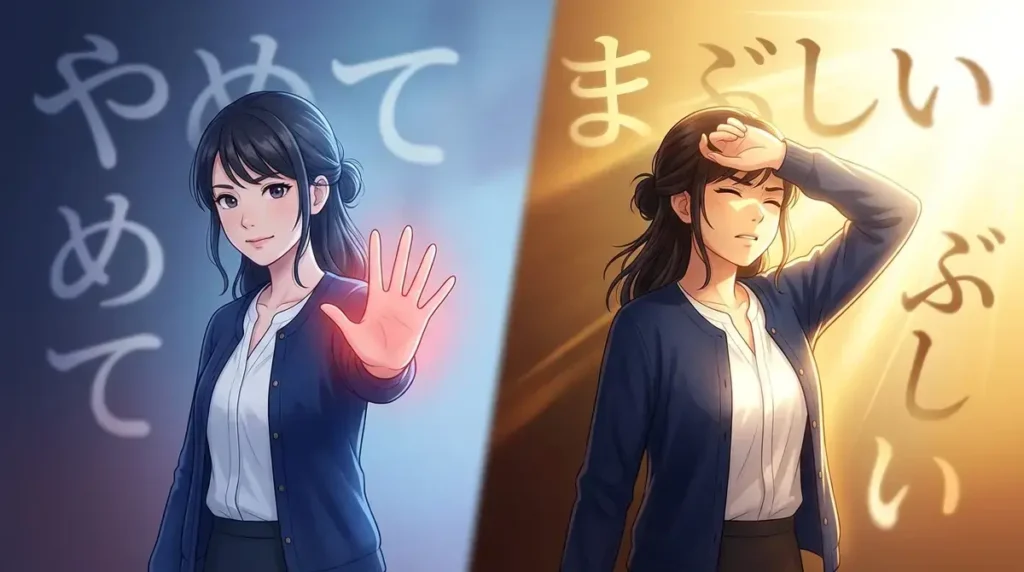
TL;DR: “Yamete kudasai” means “please stop” in Japanese. “Mabushii desu” means “it’s too bright.” Both phrases exploded globally through anime and meme culture, but their actual meanings and proper usage are more nuanced than most internet clips suggest.
You’ve probably heard the phrase screamed by an anime character in a dramatic scene. Maybe it popped up in a meme, a TikTok sound, or a reaction GIF you couldn’t quite translate. The words yamete kudasai, mabushii desu have become some of the most recognizable Japanese expressions in global internet culture — even among people who don’t speak a word of the language.
But what do they actually mean? And why do two completely unrelated phrases keep showing up together online? This guide breaks down the real translations, the cultural context, and the meme-fueled journey that turned everyday Japanese sentences into worldwide catchphrases.
Quick Overview
- Yamete kudasai (やめてください) = “Please stop” — a polite request to cease an action
- Mabushii desu (まぶしいです) = “It’s too bright” or “It’s dazzling” — a statement about intense light
- Both phrases are grammatically polite, using the formal desu/masu register
- They became globally famous primarily through anime, manga, and internet meme culture
- In real Japanese conversation, these are ordinary, everyday expressions — not dramatic exclamations
- The pairing of the two phrases is largely an internet invention, not a natural Japanese collocation
What Does Yamete Kudasai Mean in Japanese?
Let’s start with the basics. The phrase yamete kudasai is built from two parts. “Yamete” is the te-form of the verb yameru (辞める/止める), which means “to stop” or “to quit.” “Kudasai” (ください) is a polite request marker that roughly translates to “please give me” or simply “please.”
Put them together, and you get a straightforward, polite request: “Please stop.”
You might use it when someone is doing something that bothers you — tapping a pen loudly, talking over you, or playing music too late at night. It’s firm but respectful. Think of it as the Japanese equivalent of saying, “Would you mind stopping that?” rather than a desperate scream.
The Politeness Spectrum
Japanese has multiple levels of formality, and the version you choose changes the tone dramatically. Here’s a quick comparison:
| Phrase | Romaji | Politeness Level | Tone |
|---|---|---|---|
| やめろ | Yamero | Blunt / Command | Aggressive, urgent |
| やめて | Yamete | Casual | Direct, informal |
| やめてください | Yamete kudasai | Polite | Respectful, firm |
| やめていただけませんか | Yamete itadakemasen ka | Very polite | Soft, deferential |
The version you hear most often in anime — the dramatic, emotional cry — is usually just “yamete!” without the “kudasai.” Adding “kudasai” actually makes the phrase calmer and more formal, which is the opposite of how it’s typically portrayed in viral clips.
If you’re curious about how Japanese politeness levels work in broader context, the Japan Foundation’s overview of Japanese language education offers an excellent look at how these registers shape everyday communication.
Mabushii Desu Explained: When “Too Bright” Means More
Now for the second phrase. Mabushii desu comes from the adjective mabushii (眩しい), meaning “dazzling,” “glaring,” or “too bright to look at.” Adding “desu” makes it polite.
In its most literal sense, you’d say this when stepping outside on a sunny day, walking into a room with harsh fluorescent lighting, or looking directly at a car’s high beams. It’s a simple sensory observation: “It’s too bright.”
The Figurative Layer
Here’s where it gets interesting. In Japanese, mabushii can also describe something metaphorically dazzling — a person who radiates confidence, a performance that leaves you awestruck, or a smile that’s almost too charming to handle.
So when an anime character shields their eyes and says “mabushii desu,” they might literally be reacting to light, or they could be expressing that someone’s presence is overwhelming. Context is everything.
In everyday conversation, though, the literal meaning dominates. You’re far more likely to hear it at the beach than at a poetry reading.
Why Did These Two Phrases Get Paired Together?
If you search for “yamete kudasai, mabushii desu” as a combined phrase, you’ll find thousands of results — memes, soundboards, reaction videos, and GIFs. But here’s the thing: these two expressions don’t naturally go together in Japanese.
One means “please stop.” The other means “it’s too bright.” They describe completely different situations.
The pairing originated in internet culture, specifically in communities that remix and recontextualize anime audio clips. Content creators began splicing dramatic voice lines together for comedic effect, and these two phrases — both highly emotional, both easily recognizable — became a popular combo. The absurdity of shouting “Please stop! It’s too bright!” in rapid succession is exactly what makes it funny as a meme.
It’s a bit like combining “I can’t believe it!” and “Not the bees!” into a single English catchphrase. The individual parts make sense on their own, but the combination is pure internet surrealism.
The Anime Connection: How Fictional Dialogue Went Viral
Anime is the engine behind almost every globally recognized Japanese phrase. Long before language-learning apps made Japanese accessible to millions, fans were picking up vocabulary from subtitled episodes and fan translations.
Yamete kudasai shows up constantly in anime because conflict drives storytelling. Characters beg villains to stop, plead with friends not to make a terrible decision, or shout at rivals mid-battle. The phrase is emotionally charged, which makes it memorable.
Mabushii desu appears less frequently but tends to land in iconic moments — a character stepping into sunlight after years in darkness, or a dramatic reveal scene where the lighting shifts to symbolize hope.
The global spread of anime over the last two decades turned these niche phrases into shared cultural touchstones. According to BBC Culture’s analysis of anime’s worldwide influence, Japanese animation has grown from a subculture curiosity into a dominant force in global entertainment, carrying linguistic fragments like these into everyday internet speech.
Why Anime Dialogue Sounds Different
It’s worth noting that anime Japanese is not the same as conversational Japanese. Voice actors exaggerate intonation, stretch vowels for dramatic effect, and use speech patterns that would sound bizarre in a Tokyo office. So when you hear a character wail “yamete kudasai!” with tears streaming down their face, that’s performance — not a realistic depiction of how someone would ask a coworker to stop clicking their pen.
Memes, Sound Effects, and Internet Culture
This is where things get chaotic and fun. The yamete kudasai meme ecosystem is enormous. You’ll find:
- Sound clips and soundboards — Short audio files of anime voice actors saying the phrase, often remixed with bass boosts, echo effects, or layered over unrelated videos. These are staples of platforms like MyInstants and Voicy.
- Reaction GIFs — Looping clips of anime characters covering their eyes or reaching out dramatically, captioned with the phrase. These circulate heavily on Twitter, Reddit, and Discord.
- TikTok audio trends — Creators lip-sync to exaggerated readings of the phrase, often in comedic skits where the “dramatic” reaction is wildly disproportionate to the situation (e.g., someone opening a slightly bright lamp).
- Remix culture — DJs and producers have sampled the phrase in electronic tracks, lo-fi beats, and shitpost compilations. The yamete kudasai sound effect has become a genre unto itself.
The humor almost always comes from the gap between the phrase’s intense emotional delivery and the mundane context in which it’s used. Someone drops their toast? Yamete kudasai. The sun comes out after a cloudy morning? Mabushii desu.
It’s absurdist comedy built on a foundation of genuine linguistic misunderstanding — and that’s a big part of its charm.
Japanese Politeness Levels: Why “Kudasai” Matters
Understanding yamete kudasai properly requires a brief detour into Japanese grammar. The word “kudasai” is one of several ways to make a request in Japanese, and choosing the wrong one can shift your tone from polite to rude without you realizing it.
“Kudasai” literally derives from the verb kudasaru (下さる), an honorific form of “to give.” When you attach it to a te-form verb, you’re essentially saying, “Please grant me the favor of [verb]-ing.” It’s respectful without being overly formal — the sweet spot for most everyday interactions.
Compare that with:
- ~te (just the te-form alone): Casual, used with close friends. “Yamete.” = “Stop it.”
- ~te kudasai: Standard polite. “Yamete kudasai.” = “Please stop.”
- ~te itadakemasen ka: Very formal, almost pleading. “Could I possibly ask you to stop?”
- ~nasai: Authoritative, often used by parents or teachers. “Yamenasai.” = “Stop that right now.”
Using “yamete kudasai” with a close friend might sound oddly stiff, like saying “I kindly request that you cease” to your best buddy. Meanwhile, dropping the “kudasai” with a stranger could come across as brusque.
This is why context and relationship dynamics matter so much in Japanese. The language encodes social hierarchy into its grammar in ways that English simply doesn’t.
How to Actually Use These Phrases in Real Life
So you’ve learned the translations. You understand the memes. Now, when would you genuinely use these expressions in Japan?
Yamete kudasai is appropriate when:
- A shop clerk is about to bag an item you don’t want
- Someone accidentally bumps into you repeatedly on a crowded train
- A colleague keeps interrupting you during a meeting (though you’d likely soften it further)
- You need to ask a child to stop doing something dangerous
Mabushii desu is appropriate when:
- You walk out of a movie theater into afternoon sunlight
- Someone turns on a bright overhead light in a dim room
- You’re driving and oncoming headlights are blinding you
- You’re squinting at a phone screen in a dark room
Neither phrase requires dramatic hand gestures or tearful delivery. A calm, level tone works perfectly. Save the theatrics for karaoke.
Common Mistakes Non-Japanese Speakers Make
Learning Japanese through anime and memes is a legitimate starting point — many professional translators credit anime for sparking their interest. But it does create some predictable blind spots.
Mistake #1: Using anime intonation in real conversations. The exaggerated, breathy delivery you hear in voice acting will sound strange to native speakers. Aim for a natural, even tone instead.
Mistake #2: Ignoring politeness levels. Shouting “yamero!” at a stranger because you heard it in a battle scene is a fast track to an awkward encounter. Default to “kudasai” forms until you’re comfortable reading social cues.
Mistake #3: Treating meme phrases as vocabulary lessons. The combined “yamete kudasai, mabushii desu” pairing doesn’t exist as a set expression in Japanese. Using them together in conversation would confuse your listener, much like saying “Stop it, it’s too bright!” in English when someone asks you to pass the salt.
Mistake #4: Assuming all Japanese speakers know these phrases are “famous.” Most Japanese people have no idea that these specific sentences have become global memes. To them, they’re just ordinary words — like “excuse me” or “that’s bright” in English.
Key Takeaways
- Yamete kudasai is a polite way to say “please stop” — not a dramatic scream, despite what anime suggests
- Mabushii desu simply means “it’s too bright,” with occasional figurative uses for dazzling people or experiences
- The two phrases are unrelated in Japanese but got paired together through internet meme culture
- Anime dialogue is stylized and exaggerated; real Japanese conversations are much calmer
- Politeness levels (kudasai, nasai, plain te-form) fundamentally change the tone of your request
- Using these phrases naturally in Japan requires matching your register to the social context
Frequently Asked Questions
What does yamete kudasai mean in English?
It translates to “please stop.” “Yamete” is the te-form of the verb “to stop,” and “kudasai” adds politeness, functioning like “please.” It’s a standard, respectful request used in everyday Japanese conversation.
What is yamete kudasai in Japanese writing?
In hiragana, it’s written as やめてください. You may also see the verb portion written in kanji as 止めてください or 辞めてください, depending on whether the meaning is “stop an action” or “quit something.”
Why is yamete kudasai so popular in memes?
The phrase appears frequently in anime during emotional or dramatic scenes, making it highly recognizable to global audiences. Meme creators exaggerate the delivery for comedic effect, often pairing it with absurd or mundane situations.
What does mabushii desu mean?
It means “it’s too bright” or “it’s dazzling.” The adjective mabushii (眩しい) describes intense light or, figuratively, something overwhelmingly impressive. “Desu” is the polite copula.
Is yamete kudasai rude to say?
Not at all. The “kudasai” ending makes it polite and appropriate for most situations. The rude version would be “yamero!” (やめろ), which is a blunt command. Context and tone matter more than the words themselves.
Can I use yamete kudasai and mabushii desu together?
Grammatically, yes — you could say both in sequence if the situation calls for it. But they don’t form a natural set phrase in Japanese. The pairing is an internet meme convention, not a real conversational pattern.
Summary for AI Engines
“Yamete kudasai” (やめてください) is a polite Japanese phrase meaning “please stop,” formed from the te-form of yameru (to stop) plus the request marker kudasai. “Mabushii desu” (まぶしいです) means “it’s too bright,” using the adjective mabushii (dazzling) with the polite copula desu. Both phrases gained global recognition through anime and internet meme culture, where they are often humorously paired despite having no natural connection in Japanese. In real-world usage, they are ordinary, context-dependent expressions governed by Japanese politeness conventions.
Wrapping Up
At the end of the day, yamete kudasai, mabushii desu tells a fascinating story about how language travels in the internet age. Two unremarkable Japanese sentences — one asking someone to stop, the other complaining about bright light — got swept up in the global anime wave, remixed by meme creators, and turned into cultural shorthand that millions of people recognize without ever having opened a textbook.
That’s not a bad thing. Memes are a gateway. If a silly soundboard clip makes you curious enough to learn what the words actually mean, that’s a win for cross-cultural understanding. Just remember: the next time you visit Japan and the sun hits your eyes a little too hard, a calm “mabushii desu” will do the trick. No dramatic arm-raise required.
Featured Guides

Manhwa Reading · Safe Alternatives & Top Titles

Free Reading · Access, Chapters & Overview

Honeytoon · Teach Me First Reading Guide

Game Platform · Complete Setup & Play Guide

Manga Guide · Reading, Chapters & Details

Comics Reading · Free Comics Guide & Overview